Đọc thử · Chương 177 · Tiếng Anh
The Voyage Continues
Looking back over twenty centuries
This book began with smoke. Anyone who stepped out of a doorway in Nazareth one spring around 4 BC could look across the hillside and see thick black smoke rolling up over Sepphoris, the busy city beyond the ridge, where Roman legions were burning houses and killing townspeople to put down a revolt. Nothing about the hill village of Nazareth seemed worth a line in a Roman chronicle. Yet behind its poor stone walls lived a carpenter’s family no one had heard of, and a child who had not yet taken his first unsteady steps.
The book ends with smoke too. On the evening of May 8, 2025, at 6:07 by the Roman clock, a plume of white smoke curled out of the narrow chimney on the roof of the Sistine Chapel. Tens of thousands of people ran from cafés, bus stops, and side streets down every avenue of Rome toward Saint Peter’s Square, craning their necks toward the balcony, to learn who would be the two hundred and sixty-seventh to sit in the place of the poor Galilean fisherman named Simon Peter. After each round of voting the cardinals burn their ballots in a small cast-iron stove, and the color of the smoke tells the crowd: black means no one has been chosen yet and the Church must keep praying; white means the boat has a new helmsman. On that spring evening, it was Pope Leo XIV.
Between the two columns of smoke, the dark smoke of Roman reprisal over Galilee and the white signal of hope over the Vatican, lie two thousand years.
What the River Carried
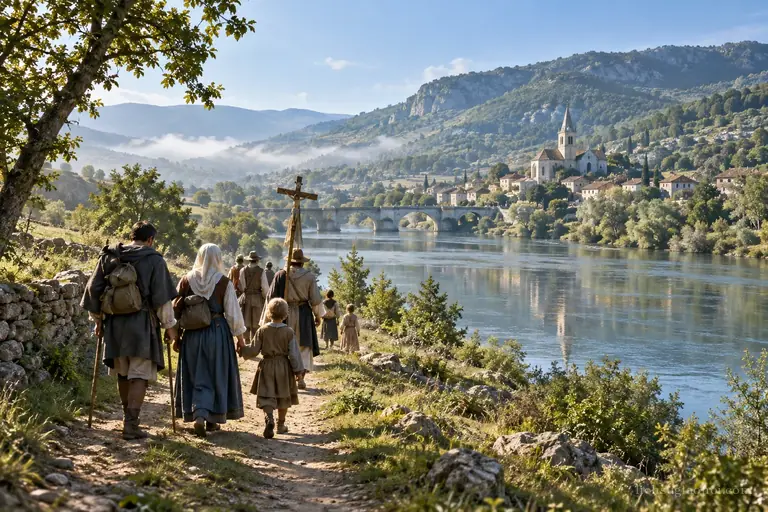
You have been through a hundred and seventy-six chapters. Close your eyes for a moment, and the sights and sounds of that long road still echo. You stood on the windy shore of the Sea of Galilee while a carpenter from Nazareth called some fishermen to drop their nets and follow him. You sat in the cool, torchlit tunnels of the catacombs under Rome and stood in the roaring arena of Carthage, where two young women, Perpetua, a noblewoman with a baby at her breast, and Felicity, a slave who had just given birth in prison, held each other’s hands and steadied one another before the charging beasts. You followed Augustine through his sleepless, tear-stained nights of struggle in a garden in Milan, Benedict up the mountain to Monte Cassino to lay the stones of a monastery that would keep prayer and learning alive through the ruin of an empire, and young Francis of Assisi, a merchant’s son, as he took off his fine clothes in the sunlit town square, handed them back to his bewildered father, and walked barefoot onto the road of poverty.
You also saw what you would rather not have seen, the pages every believer wishes had never been written. The burning stakes of the Inquisition. The Fourth Crusade, when men wearing the cross on their cloaks turned their swords in 1204 on Constantinople, the greatest Christian city in the East, and sacked the home of their Eastern brothers and sisters. Renaissance popes who sold church offices, and clergy who dressed in velvet and silk while the poor went hungry outside their gates. The wooden hulls of ships carrying Africans in chains across the Atlantic, and the old books of the Maya thrown on a fire until their memory was ash. Jews slandered, persecuted, and driven out by Christians who dared to do it in the name of the God of Abraham. Children wounded in body and soul by the very men who wore his name on their collars. This book has tried to tell those pages as plainly as they happened, not out of cynicism or bitterness but out of faithfulness to the truth, because a Church that will not look at its own sins cannot understand the mercy of God, still less preach it. Only those who know how deep human weakness goes can see how wonderful grace is.
And you met the Vietnamese inside the great flow. A boy at Thanh Chiêm, a village on the central coast, who in the early seventeenth century taught a French priest, Alexandre de Rhodes, the tones of the Vietnamese language. It was a first step toward the alphabet in which Vietnamese is written today. A young catechist, Andrew of Phú Yên, who in the summer of 1644 knelt on a mound of earth in Quảng Nam at nineteen to be killed for the faith, telling his friends to keep their love for Jesus to their last breath. The families who fled persecution in the 1790s and prayed the rosary under the trees in the forest of La Vang. The 117 Vietnamese Martyrs, canonized in 1988, whom the whole Church remembers every November 24. An archbishop, Francis Xavier Nguyễn Văn Thuận, held in prison for thirteen years, who wrote messages to his flock on the back of old calendar pages. And today, young factory workers in the industrial towns near Saigon who, after a twelve-hour shift, wash their hands and hurry to the nine o’clock evening Mass.
A Strange Thing
Look at all two thousand years and one thing stands out, something every historian has to admit: by every ordinary law of history this boat should have sunk centuries ago, and this river should have run dry long ago.
It began with a group of people who had nothing in their hands, a few weather-beaten fishermen, some poor women, and a tax collector with a bad name, huddled behind locked doors in a remote province of an empire, only days after their Teacher had been executed in disgrace on a Roman cross. Emperors turned the whole machinery of the mightiest state on earth against it, on and off, for three hundred years, to grind it to dust. In 1054 it divided in two, and in 1517 it split into many streams. Its own shepherds fouled its waters again and again with ambition, greed, and hunger for power. At the end of August 1799, at the height of the Revolution, a pope died as a prisoner in the fortress of Valence, in France, an old man of eighty-one dragged from Rome, stripped of everything, and cut off from the world. The revolutionary clerk opened the town’s death register and, in the column for the dead man’s trade, wrote with cold precision: “Occupation: Pope.” As far as the revolutionaries were concerned, that old trade had gone out of business, and Pius VI was the last of his kind. In the twentieth century, the strongest regimes in human history, from Hitler’s Germany to Stalin’s Soviet Union and Mao’s China, set out with secret police, prison camps, and vast machines of propaganda to wipe the name of Jesus Christ out of human memory.
It is still here. Not because the people steering the boat have been cleverer, better planners, or morally better than others. The people who carry it are no cleverer or holier than anyone else, as weak, stubborn, and prone to stumbling as every child of Adam; the chapters of this book have shown them to be as weak as the rest of us. In the Acts of the Apostles, when the high priests of the Sanhedrin were furious and wanted to put the apostles to death, a respected Pharisee and teacher of the Law named Gamaliel rose in the council and told them to leave the apostles alone: “For if this counsel or this work is of men, it will be overthrown. But if it is of God, you will not be able to overthrow it” (Acts 5:38–39). Tertullian, one of the first Christian writers in Latin, writing in Carthage around 197 while Roman judges were still sending believers to the sword and the arena, wrote a line that has been repeated ever since:
“The blood of the martyrs is the seed of Christians.”
Christians have an answer to the strange thing, the one anchor that has held the Church through ten thousand storms. It is the promise the risen Christ spoke on a mountain in Galilee before he ascended, the last words of Matthew’s Gospel: “Behold, I am with you always, even to the end of the age” (Matt 28:20).
The People with No Names
The history of the Church is usually told through the names of popes, councils, and kings. This book has told much of it that way. But the river did not flow because of them so much as because of billions of hidden, ordinary people whose names will never appear in any history book, who fed it, deepened it, and kept it alive.
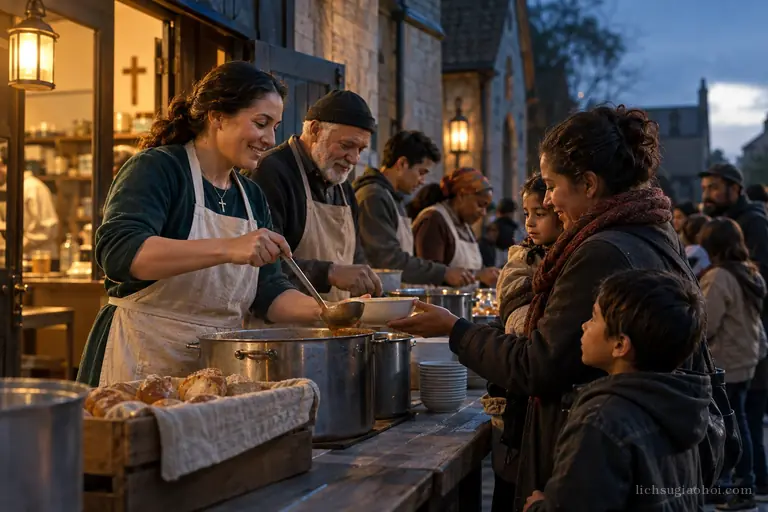
Mothers, worn by sun and work, who knelt beside their small children each evening and guided their tiny fingers to make the sign of the cross before a meal. In Vietnam, the village elders called ông trùm and cụ quản, lay men who risked arrest and beatings to hide the baptism register in a bamboo wall through years when no priest could come. Bent grandmothers who sat night after night by a flickering oil lamp in mud-walled houses, passing worn wooden beads between their fingers, praying for children and grandchildren scattered across the world. Millions of catechists on every continent who gave up their Sunday mornings, without a coin of pay, to teach restless rooms of children their prayers. Sisters kneeling on concrete floors to wash the open sores of lepers whom no one else would look at. Tens of thousands of nameless martyrs who fell in mountain forests, sank in dark rivers, or wasted away in forgotten prison cells, with no stone to carry their names, their bones long since mixed with the earth.
Even the apostle Paul knew this. Around the year 57, after climbing some of the highest peaks of theology in all of Scripture, he closed his Letter to the Romans with a whole page of greetings to his humble friends by name: Phoebe, who had been a helper of many; Prisca and Aquila, the Jewish tentmakers who risked their necks for him; Mary, who worked hard for them; Andronicus and Junia, his fellow prisoners, who were in Christ before him. We know them only from that page. In the eyes of the Roman Empire not one of them mattered. They were not famous in their own time.
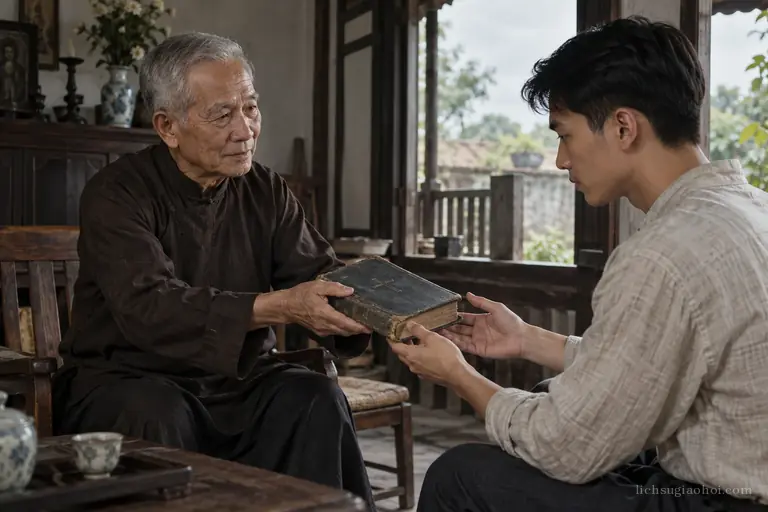
Two thousand years ago the faith was handed from one person to the next in words, over a shared meal, in the way a life was lived. It is still handed on that way, not mainly by decrees or orders, but heart to heart: a quiet word across a family kitchen table, a hidden sacrifice to carry someone else’s burden, a life given away for love. Every living Catholic can trace the chain backward: from the priest or parent who brought you to the water of baptism, to the person who baptized your mother and father, back up the centuries through grandparents, village elders, missionaries, catechists, mothers, and martyrs, all the way to a morning on the shore of the Sea of Galilee, when Jesus of Nazareth looked straight into the eyes of ordinary fishermen and said, “Follow me.” It is a cord of grace that has never once broken in twenty centuries, and at this end of it are the hands that hold this book.
Ahead
No one knows what the next two thousand years will look like. The old stone cathedrals of Europe may pass through long, hushed winters, while young, poor communities across Asia, Africa, and Latin America fill with song and missionary fire. On some morning still hidden in God’s plan, Catholics and Orthodox may again gather at one table and break one bread together. Machines that talk and reason, and the new powers of biotechnology, may change human life in ways no one can picture today. There will be new persecutions, new storms of trial and purification, and new saints growing quietly in the middle of ordinary life.
The first disciples, coming down the stairs from the upper room in Jerusalem, did not know either. They had no map of the centuries ahead. They could not have pictured cathedrals in Paris, parishes in the Mekong Delta, or white smoke over Rome two thousand years later. They knew only that their Master was risen and had told them to go to the ends of the earth, and they had the courage to take the first step.
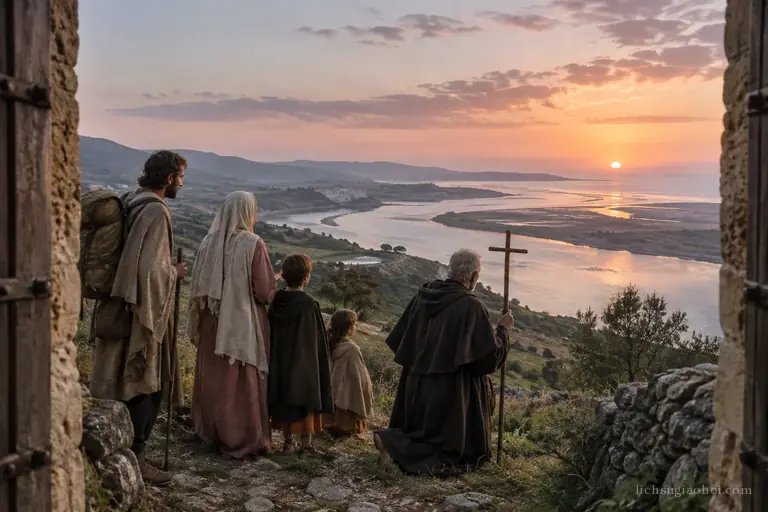
In the dusk of the first Easter Sunday, two disciples had turned their backs on Jerusalem and were trudging along the dusty road to a village called Emmaus, about seven miles (eleven kilometers) away, talking quietly and sadly about everything that had happened. Their Master had died in shame on a cross, and every hope they had seemed to have died with him. A stranger came up and walked with them. He did not interrupt them with a lecture. He walked at their pace and listened patiently while they poured out all their disappointment and grief, and only then did he open the Scriptures to them, from Moses and all the prophets, so they could understand the mystery of the cross. When the shadows lengthened and evening came over the hills, they begged him to stay with them. When they sat down at table, he took the bread and gave thanks. Breaking it, he gave it to them. “Their eyes were opened and they recognized him; then he vanished out of their sight.” They said to one another, “Weren’t our hearts burning within us while he spoke to us along the way, and while he opened the Scriptures to us?” The fear of the dark fell away, and so did the ache of the long road. They rose up that very hour and hurried back to Jerusalem, in the dark, to tell the others that the Lord was truly risen.
The Church began that way, and after twenty centuries it is still that way: weak, wandering, sinful people on the road meet the Living One, and once their hearts are set on fire, they cannot keep it to themselves, and they turn back to tell others.
This book stops here. The river does not. The wind of the Holy Spirit still blows over the water, calling the boat of God’s people to raise its sails and put out into the deep, carrying love, mercy, and the hope of the Gospel down every road to the ends of the earth.
Where to Find Them Today
Sepphoris, Galilee. The city whose smoke opened this book is now Zippori National Park, about an hour’s walk across the hills from Nazareth. Its excavated streets, theater, and mosaic floors, among them a woman’s face that guides call the Mona Lisa of the Galilee, show the kind of town a carpenter from the next village might have worked in.
Tabgha, on the Sea of Galilee. On the shore below the hills, the small Church of the Primacy of Saint Peter stands over a flat rock that pilgrims call the Mensa Christi, the Table of Christ, where tradition remembers the risen Jesus cooking breakfast for his disciples and telling Peter to feed his sheep.
Nazareth, Galilee. The Basilica of the Annunciation, the largest church in the Middle East, stands over the old grotto that Christian tradition honors as the home of Mary.
The Sistine Chapel, Vatican City. Whenever the cardinals meet in conclave under Michelangelo’s frescoes, the narrow chimney on the chapel’s roof still sends black or white smoke into the Roman sky.
Emmaus. No one is sure where the village stood. Three places claim it, Emmaus Nicopolis, Abu Ghosh, and El Qubeibeh, and pilgrims walk to all three, which may be fitting for a road on which the disciples did not recognize who walked beside them.