Đọc thử · Chương 2 · Tiếng Anh
The Quiet Years in Nazareth
Around 6 BC to around AD 28 · Nazareth, Bethlehem, Jerusalem, Egypt
Nazareth was a poor, out-of-the-way village tucked into a fold of limestone hills in Lower Galilee, in the north of the Holy Land. Probably a few hundred people lived there. The houses were low, with walls of rough fieldstone and flat roofs of wooden beams packed over with clay and chopped straw against the summer sun and the winter rain. The villagers lived from a few terraced plots cut into stony ground, some gnarled olive and fig trees, and goats grazing on the thin grass of the dry slopes.
The whole village drew its water from one well, fed by a single spring. At first light, and again as the afternoon shadows lengthened, the women and girls came with clay jars balanced on their heads to fill them and trade news of harvests, rain, births, and coming weddings. In 2009 the Israeli archaeologist Yardenna Alexandre excavated the first house ever found from the Jewish village, dated to the time of Jesus: plain stone walls, with pits and cellars cut into the rock beneath the floor to keep grain and oil cool through the dry season.
Among the girls at the well was one named Mary. She was a devout young girl, recently engaged to Joseph, a quiet, upright craftsman of the village. Under Jewish custom an engagement, the kiddushin, already carried the full legal weight of a marriage, but for about a year the bride still lived in her parents’ house, waiting for the day the groom would come in procession to lead her to his home. An ordinary life, like the lives of thousands of other girls, was opening before her.
The Greeting at Nazareth
Luke tells what happened next in plain words. The angel Gabriel was sent to Nazareth, to “a virgin pledged to be married to a man whose name was Joseph, of David’s house.” He said to her: “Rejoice, you highly favored one! The Lord is with you. Blessed are you among women!” (Luke 1:28).
Mary was greatly troubled, Luke says, and she pondered in her heart what kind of greeting this might be. It was not the panic of someone frightened by a vision but the sober thought of a young woman who took God’s word seriously. The angel steadied her. She had found favor with God, he said, and she would bear a son and name him Jesus. He “will be called the Son of the Most High. The Lord God will give him the throne of his father David,” and his Kingdom would never end (Luke 1:30–33).
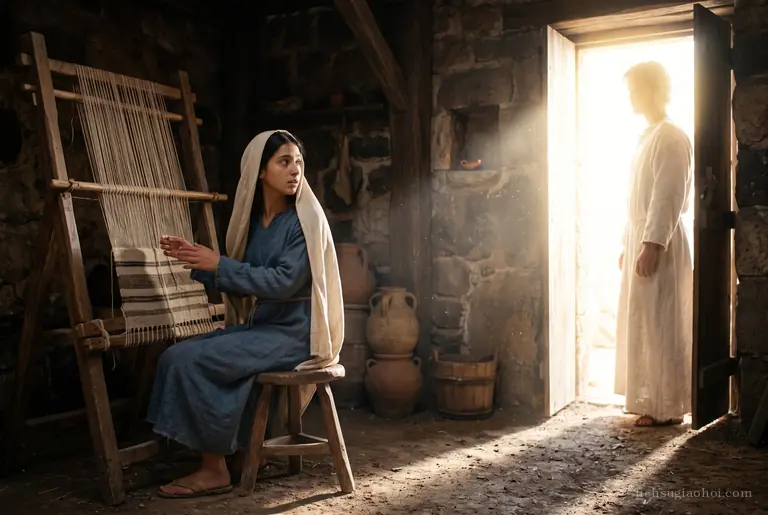
Mary was probably fifteen or sixteen, an age at which girls of her time were often engaged. She did not bow her head and agree at once. She asked a plain, honest question about how God would do it: “How can this be, seeing I am a virgin?” (Luke 1:34). The angel answered that the Holy Spirit would come on her and “the power of the Most High will overshadow you.” A Jewish listener would remember the cloud of God’s glory that once covered the Tent of Meeting in the desert (Exod 40:34). The angel added “nothing spoken by God is impossible” (Luke 1:35, 37).
Then Mary bowed her head in humble trust and said: “Behold, the servant of the Lord; let it be done to me according to your word” (Luke 1:38).
Around AD 180, less than two centuries later, Irenaeus, bishop of Lyon in Roman Gaul, what is now France, set that answer beside Eve’s refusal in the Garden of Eden. He wrote: “The knot of Eve’s disobedience was loosed by the obedience of Mary. For what the virgin Eve had bound fast through unbelief, this did the virgin Mary set free through faith” (Against Heresies 3.22.4).
Catholics still pray with the greetings of this story. The first half of the Hail Mary is built from Gabriel’s words (Luke 1:28) and Elizabeth’s (Luke 1:42). The Church keeps the feast of the Annunciation on March 25, exactly nine months before Christmas.
Luke does not say where in Nazareth it happened. Orthodox tradition, following the second-century Protoevangelium of James, places it at the village spring. Catholic tradition points to a small rock-cut grotto that once formed the back room of a village house, now enclosed under the dome of the Basilica of the Annunciation, where the marble below the altar bears the words Verbum caro hic factum est, “The Word was made flesh here.”
For two thousand years, Christians have counted that short answer as the moment everything began.
The Man Who Never Says a Word
What about Joseph?
Matthew tells the story from his side. Joseph learned that Mary was expecting a child while she was still living under her parents’ roof, before they had begun to live together. In a village of a few hundred people, where everyone knew everyone, it was a heavy blow. Under the Law of Moses he could have accused her before the elders at the village gate, and a betrothed girl found pregnant could be dragged before them and stoned (Deut 22:23–24). Under Roman rule the penalty was rarely carried out, but a public accusation still meant ruin and disgrace for life. But Matthew calls Joseph “a righteous man,” one “not willing to make her a public example.” His righteousness was faithfulness to God’s Law, filled with mercy. Unwilling to shame Mary or put her in danger, he chose the quietest way. He decided to “put her away secretly,” that is, to divorce her privately and let whatever gossip came fall on himself. He lay awake at night turning it over.
While he was thinking this over, an angel appeared to him in a dream: “Joseph, son of David, don’t be afraid to take to yourself Mary as your wife, for that which is conceived in her is of the Holy Spirit.” Joseph himself would give the child his name, and so adopt him into his household as a son of David. He must be named Jesus, in Hebrew Yeshua, which means “the LORD saves,” the angel said, “for it is he who shall save his people from their sins” (Matt 1:20–21).
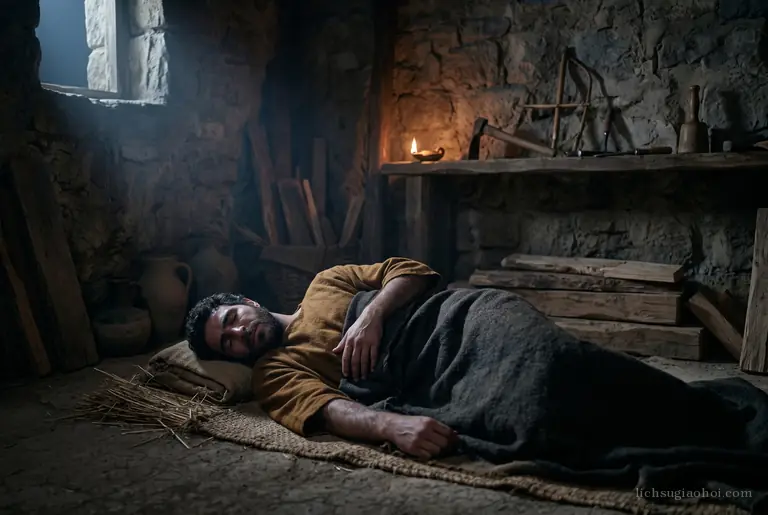
When Joseph woke, he asked for no sign and no explanation. He did exactly as the angel had told him (Matt 1:24).
In all four Gospels, not one word of Joseph is recorded. He acts. He takes Mary into his home, guides her, heavily pregnant, over ninety miles of mountain road to Bethlehem, stands up on the eighth day to give the child his name, wakes the family in the dead of night to cross the desert border into Egypt, and leads them back. Day after day he bends over saw, plane, and chisel to earn their bread. He was the kind of man every village has: quiet, hardworking, doing what needs to be done without asking for credit. In 1870 Pope Pius IX declared him patron of the universal Church. A hundred and fifty years later, in December 2020, Pope Francis wrote a letter about him, Patris Corde, “With a Father’s Heart.”
A Family Tree with Four Women
Matthew wrote mainly for Jewish readers, and he opens his Gospel with a family tree. It runs in three sets of fourteen generations, forty-two in all: from Abraham to David, from David to the exile in Babylon, and from the exile to the Christ (Matt 1:17). Its purpose was to place Jesus in the covenant line and the royal family of David through his legal father, Joseph: “Abraham became the father of Isaac. Isaac became the father of Jacob. Jacob became the father of Judah.” It begins with Abraham and ends with “Joseph, the husband of Mary, from whom was born Jesus, who is called Christ” (Matt 1:16). Every earlier line says that a man “became the father of” the next. The last line breaks the pattern and says only that Jesus was born from Mary. In the Greek, “from whom” is feminine and points to Mary alone. Jesus was not Joseph’s son by blood, yet through Joseph’s lawful marriage to Mary he received every title and promise of David’s house.
Many readers skip such lists. A Jewish reader went through them name by name, because each name opened a chapter of Israel’s memory, its triumphs, failures, exile, and longing, the way a family leans over an old family tree. Four women appear here, which was unusual, because such lists usually named only the men. They are not the honored mothers of Israel, Sarah, Rebekah, and Rachel. Each is a foreigner or has a story far from polished. Tamar was a Canaanite widow, twice cheated of her rights by her late husband’s family, who risked her life by veiling herself as a prostitute by the roadside to bear a child by her father-in-law, Judah, until Judah himself confessed: “She is more righteous than I” (Gen 38:26). Rahab was a prostitute in Jericho who defied her own king, hid two Israelite spies under stalks of flax on her roof, and put her faith in Israel’s God before the walls fell (Josh 2). Ruth was a widow from Moab, a people Israel was forbidden to marry, who clung to her penniless mother-in-law, Naomi, followed her to Bethlehem, and gleaned in the fields to feed her (Ruth 1–2). The fourth Matthew does not even name: he calls her the one who had been Uriah’s wife. She was Bathsheba. King David committed adultery with her, then arranged for her husband, Uriah, a loyal soldier, to die in battle (2 Sam 11).
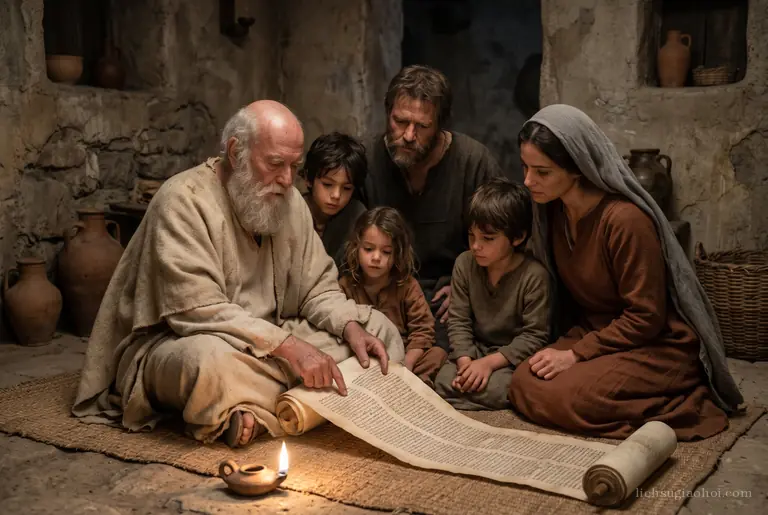
Matthew left those names in. The family tree of Jesus had its glory and its shame, its sins and its pardons, like any family’s.
The Meeting in the Hills
Gabriel had given Mary a sign: her relative Elizabeth, though old and childless, was six months pregnant (Luke 1:36). Elizabeth was the wife of Zechariah, a priest in the Temple at Jerusalem, and for years she had carried the sorrow of being childless. Mary set out at once to lend her a hand. Luke says she “went into the hill country with haste,” to a town in Judea, three or four hard days’ walk to the south, along steep, rocky tracks through bare passes and dusty valleys (Luke 1:39). She stayed about three months (Luke 1:56), probably until John was born, and then walked home to Nazareth.
Mary entered Zechariah’s house and greeted Elizabeth. At the sound of Mary’s voice the child in Elizabeth’s womb leaped for joy, Luke says. Elizabeth was filled with the Holy Spirit and cried out: “Blessed are you among women, and blessed is the fruit of your womb!” (Luke 1:42). “Why am I so favored,” she asked, “that the mother of my Lord should come to me?” (Luke 1:43).
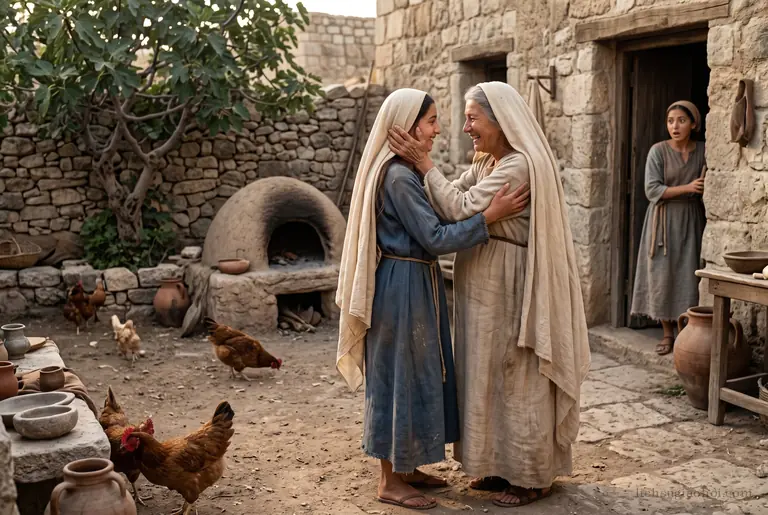
Then Mary sang. The Church still sings her song every evening, in Evening Prayer; Anglicans sing it at Evensong, and the Orthodox at Matins. It is called the Magnificat, from the first word of its Latin text: “My soul magnifies the Lord. My spirit has rejoiced in God my Savior” (Luke 1:46–47).
The song echoes the prayer of Hannah, mother of the prophet Samuel: “He raises up the poor out of the dust” (1 Sam 2:8). Mary sang in an occupied land, under Roman troops and the heavy taxes of client kings, and her version has lines that startle the listener: “He has shown strength with his arm. He has scattered the proud in the imagination of their hearts. He has put down princes from their thrones, and has exalted the lowly. He has filled the hungry with good things. He has sent the rich away empty” (Luke 1:52–53).
Those are not soft, decorative verses. They turn the whole order of worldly power upside down. That village girl was sure that God stands with the lowly.
The Road to Bethlehem
Luke now moves the story onto the largest stage in the world. He writes: “Now in those days, a decree went out from Caesar Augustus that all the world should be enrolled” (Luke 2:1). The Romans wanted to know who lived where, and drew up registers of people and land so that they could collect taxes. Luke ties the birth of Christ to real public history, where the power of Rome met the promises to Israel. As Luke tells it, each man had to register in the town of his ancestors. Joseph belonged to the family of King David, so he went to David’s town, Bethlehem, and took Mary with him.
Luke dates the decree to the time “when Quirinius was governor of Syria” (Luke 2:2). Josephus records a census under Quirinius in AD 6, nearly ten years after Herod’s death. Historians still debate how to fit the two dates together. Perhaps the registration began in Herod’s last years and was finished under Quirinius. Or perhaps, as some scholars read Luke’s Greek, it was a census held before Quirinius was governor.
From Nazareth to Bethlehem is about 90 miles (150 kilometers) over hill country, winding through hills and valleys and around hostile stretches, close to a week on foot, perhaps with a small donkey carrying their bundles. Mary was near the time of her delivery. When they arrived, Bethlehem was already full of kinsmen who had come to register.
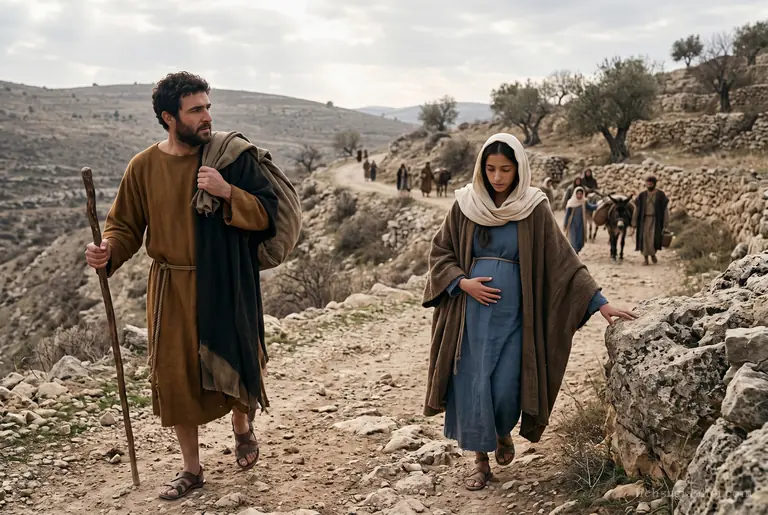
In Bethlehem they could find no place to stay. Luke writes: “She gave birth to her firstborn son. She wrapped him in bands of cloth and laid him in a feeding trough, because there was no room for them in the inn” (Luke 2:7).
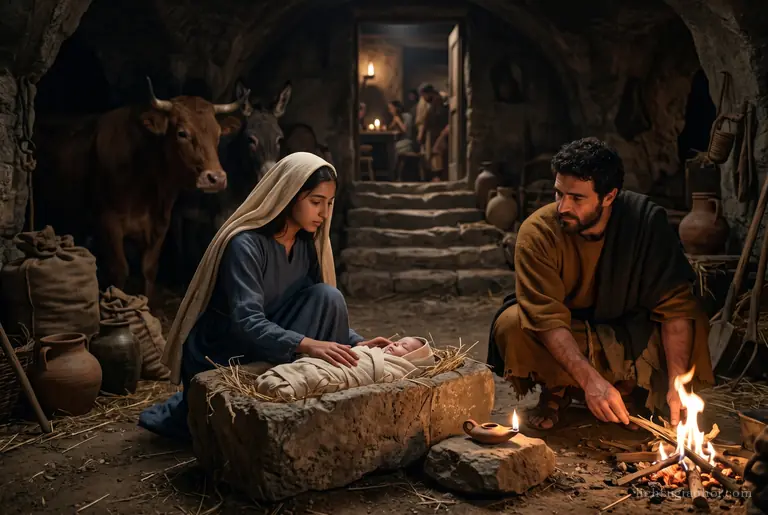
Christmas plays often have an innkeeper who slams the door, but Luke never mentions one. His word for “inn,” katalyma, is the one he later uses for the “guest room” of the Last Supper (Luke 22:11), while the inn of the Good Samaritan gets a different word, pandocheion (Luke 10:34). So some scholars think the family found a relative’s guest room already full, and they went down to the lower part of the house, or to a cave cut into the rock behind it, where peasant families brought the ox, the donkey, or the sheep in at night. The manger was a stone feeding trough hollowed out for the animals, in a dim shelter that smelled of straw and livestock. From very early on, at least from the second century, Christians pointed to a cave in Bethlehem. Around 155, Justin, a philosopher born in Samaria not far away, wrote that “since Joseph could not find a lodging in that village, he took up his quarters in a certain cave near the village; and while they were there Mary brought forth the Christ and placed Him in a manger.” About a century later Origen, who lived in Palestine, told a pagan critic that anyone who wanted proof outside the Gospels could go and look: “There is shown at Bethlehem the cave where He was born, and the manger in the cave where He was wrapped in swaddling-clothes.” The place, he added, was “greatly talked of in surrounding places, even among the enemies of the faith.” The Church of the Nativity stands over that cave today.
In Rome, Augustus was hailed in the temples of the East as “son of a god” and “bringer of peace to the world.” One stroke of his pen set tens of thousands walking the roads. He had no idea that his order served a Hebrew prophecy spoken seven centuries before by Micah, and guided a carpenter to Bethlehem for the birth of the Prince of Peace. In Bethlehem the child lay in a feeding trough, beside a craftsman and a young wife who could not find a room.
Luke says the news went first to shepherds keeping watch over their flocks through the chilly dark in the fields outside Bethlehem (Luke 2:8). An angel stood before them, and the glory of the Lord blazed around them. The angel told them: “For there is born to you today, in David’s city, a Savior, who is Christ the Lord” (Luke 2:11). Then the sky filled with a great company of angels, singing: “Glory to God in the highest, on earth peace, good will toward men” (Luke 2:14). Catholics hear those words at Mass on most Sundays outside Advent and Lent, because the Gloria begins with them.
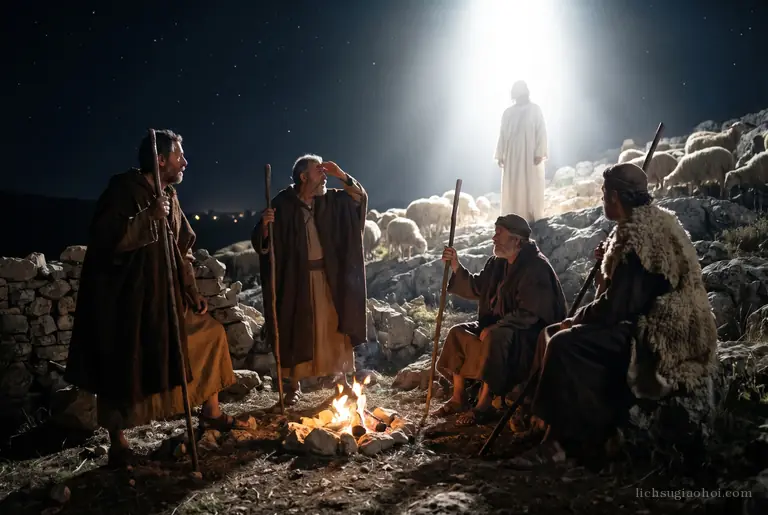
Shepherds were poor hired men who lived outdoors with their animals and could seldom keep the purity customs of the Pharisees. Some later Jewish writings say a shepherd’s word was not accepted in court, though no one can say whether that was already so in the days of Jesus. Luke’s point is plain: the first to hear the news, and the first to come and see the child, were poor laborers on the night shift, watching sheep in the cold dew.
The Old Man in the Temple
On the eighth day the child was circumcised, as the covenant with Abraham required, and given the name Jesus (Luke 2:21). Forty days after the birth, the Law of Moses asked a mother to offer a sacrifice and a family to present a firstborn son to God (Luke 2:22–24). The offering recalled the firstborn of Israel, spared on the night of the Passover in Egypt (Exod 13:2, 15). Joseph and Mary carried the child up the six-mile road from Bethlehem to the Temple in Jerusalem. The law asked for a year-old lamb as a burnt offering, with a young pigeon or a turtledove for a sin offering (Lev 12:6), but it allowed a poor family to bring birds instead: “A pair of turtledoves, or two young pigeons” (Luke 2:24). They walked through the Temple gates carrying the offering of the poor.
In the Temple courts was an old man named Simeon, “righteous and devout, looking for the consolation of Israel” (Luke 2:25). He had waited his whole life. The Holy Spirit rested on him and had shown him in prayer that he would not die before he had seen the Lord’s Messiah. Led by the Spirit, he came into the Temple just as the young couple brought the child in (Luke 2:27). He took the child in his arms and said: “Now you are releasing your servant, Master, according to your word, in peace; for my eyes have seen your salvation, which you have prepared before the face of all peoples; a light for revelation to the nations, and the glory of your people Israel” (Luke 2:29–32).
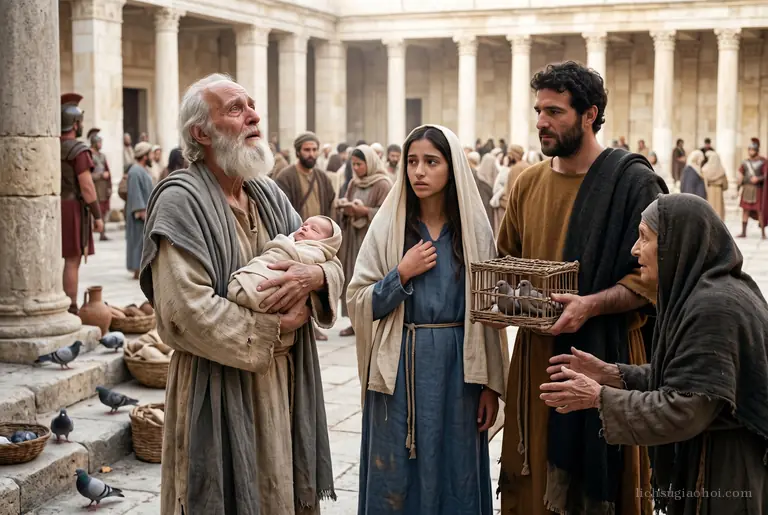
Then he turned to Mary. The child, he said, was “appointed for the falling and the rising of many in Israel, and for a sign which is spoken against” (Luke 2:34). And he spoke a hard word to her: “Yes, a sword will pierce through your own soul, that the thoughts of many hearts may be revealed” (Luke 2:35).
The Church still prays Simeon’s song every night, before sleep. It is part of Night Prayer, under its Latin name, the Nunc dimittis, and priests, monks, nuns, and lay Catholics say it to put their sleep and their lives in God’s hands. Catholic devotion counts the sword in his words as the first of the Seven Sorrows of Mary. The flight into Egypt will be the second, and the boy lost in the Temple the third.
Beside him stood Anna, a prophet of the tribe of Asher, who had been married only seven years when her husband died (Luke 2:36). Luke says she had been “a widow for about eighty-four years,” which would make her more than a hundred. Some translations read instead that she was eighty-four years old, because the Greek can be taken either way. She “didn’t depart from the temple, worshiping with fastings and petitions night and day” (Luke 2:37). She came forward just then, thanked God, and spoke about the child to everyone who was waiting for Jerusalem to be set free.
Among the marble colonnades crowded with scribes, rich patrons, and officials, not one of the powerful noticed the poor Galilean couple with their two small birds. Only two frail old people, who had waited all their lives, had eyes to see God in a peasant mother’s arms, and saw what they had waited for.
Escape to Egypt
Matthew tells a darker story. Wise men from the east came to Jerusalem and asked: “Where is he who is born King of the Jews? For we saw his star in the east, and have come to worship him” (Matt 2:2). Matthew calls them magoi, a Greek word for learned men skilled in reading the heavens, probably from Persia or Mesopotamia, who studied the stars. He does not say how many there were, or that they were kings. The number three comes from the three gifts. The “Three Kings” came later, when the gifts were joined to Old Testament verses that picture distant kings coming to honor Israel’s light.
The question soon reached King Herod, who “was troubled, and all Jerusalem with him” (Matt 2:3). The city had reason to be afraid. Herod was old by now, and his suspicion had curdled into paranoia; he saw plots behind every curtain. Josephus records that he had his wife Mariamne, a queen of the old Hasmonean line, put to death, the woman he had loved more than anyone, then had two of their sons strangled for treason, and finally his eldest son, Antipater, five days before he died himself. A king who would kill his own wife and sons had now heard of a newborn “King of the Jews.”
Herod called together the chief priests and scribes and asked where the Messiah was to be born. “In Bethlehem of Judea,” they told him, because the prophet Micah had named it (Matt 2:5–6). Herod called the wise men in secretly and “learned from them exactly what time the star appeared” (Matt 2:7). Then he sent them to Bethlehem: “Go and search diligently for the young child. When you have found him, bring me word, so that I also may come and worship him” (Matt 2:8). He was only pretending.
The star went ahead of them “until it came and stood over where the young child was” (Matt 2:9). They came into the house, saw the child with Mary his mother, and fell down to worship him. “Opening their treasures, they offered to him gifts: gold, frankincense, and myrrh” (Matt 2:11). Origen, a Christian teacher of the third century, read the gifts as signs: gold, the tribute owed a king; incense, the worship owed to God; and myrrh, the bitter resin used to anoint bodies for burial, for a man who would die. Warned in a dream, the wise men went home by another road. Many Catholics celebrate their visit on Epiphany, the day the Savior showed himself to the Gentile nations, around January 6, known as Three Kings Day in Latin America and the Philippines.
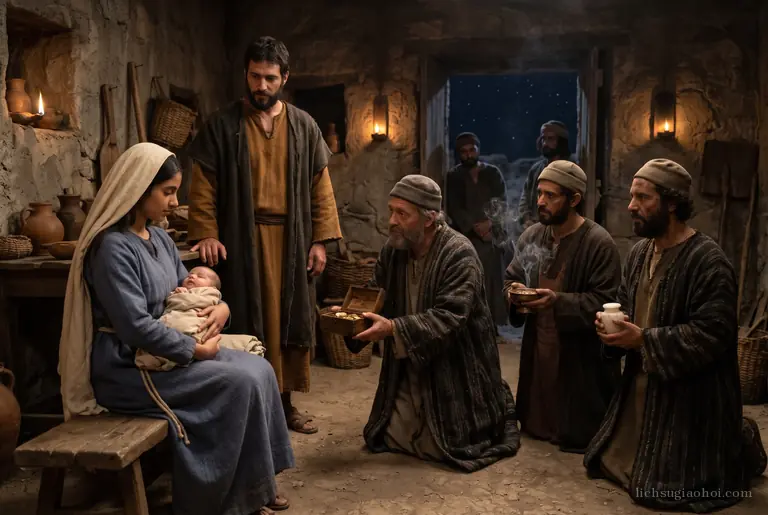
Then Joseph had a second dream. The angel said: “Arise and take the young child and his mother, and flee into Egypt, and stay there until I tell you, for Herod will seek the young child to destroy him” (Matt 2:13). Joseph woke Mary, gathered what little they could carry, took the child, and left that same night on the dark road of exile.
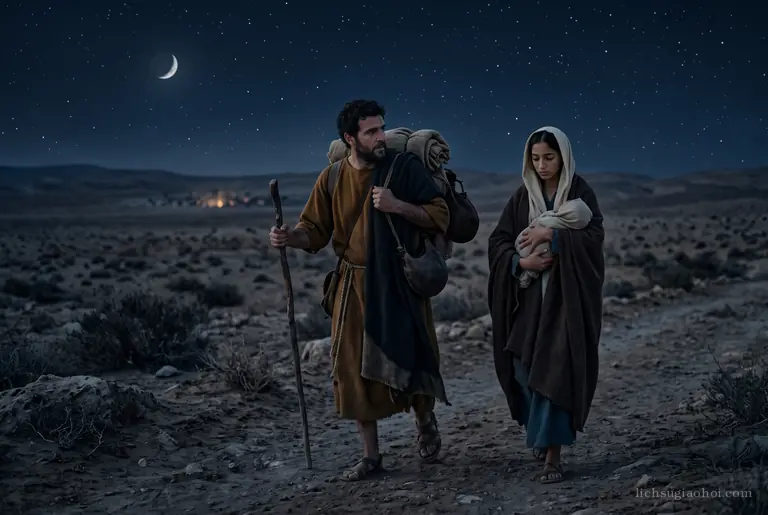
So from the first days of his life, Jesus belonged to a refugee family. They left their home, crossed a border in the dark with a baby in their arms to escape a ruler who wanted him dead, and lived as guests in a foreign land. They would have crossed the scorching country of Sinai. Egypt was a natural place to run, since it was ruled directly by Rome, beyond Herod’s reach, and held one of the largest Jewish communities in the world, in Alexandria and in settlements along the Nile, where a craftsman could find work. How long the family stayed, no one knows.
In 1952, with millions still homeless in the rubble of the Second World War, Pope Pius XII wrote, in Exsul Familia Nazarethana, “The Exiled Family of Nazareth,” his apostolic constitution on migrants: “The émigré Holy Family of Nazareth, fleeing into Egypt, is the archetype of every refugee family.”
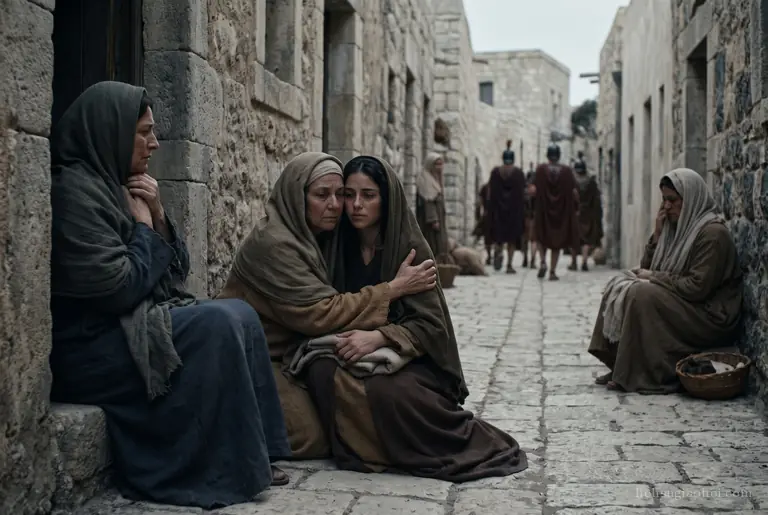
Back in Bethlehem, Herod learned that the wise men had tricked him. Reckoning from the time of the star the wise men had told him, he sent soldiers into Bethlehem and the hamlets around it to kill “all the male children who were in Bethlehem and in all the surrounding countryside, from two years old and under” (Matt 2:16). No other ancient writer mentions this, not even Josephus, who recorded so many of Herod’s crimes. Bethlehem was a small town of perhaps a thousand people, so the boys killed probably numbered ten or twenty, a crime easily lost among the thousands Herod killed in Jerusalem.
Matthew hears in it the voice of Jeremiah: “A voice was heard in Ramah, lamentation, weeping and great mourning, Rachel weeping for her children; she wouldn’t be comforted, because they are no more” (Matt 2:18). Rachel, the wife of Jacob, was buried by the road into Bethlehem (Gen 35:19), close enough to hear the mothers weep as armed men broke through their doors. Three days after Christmas, on December 28, priests put on red vestments for the feast of the Holy Innocents, and the Church honors the murdered boys as martyrs, the first to shed their blood for Christ. Beside the star and the angels’ song, the Christmas story holds this weeping too.
Herod died in the spring of 4 BC, after a long and painful illness, and even his death was planned as a massacre. Josephus tells it. Knowing the people would rejoice when he was gone, the dying king had the leading men of every village in Judea locked inside the hippodrome at Jericho. He told his sister Salome that the moment he breathed his last, soldiers were to surround the place and kill them all, so that he would have “a great mourning at his funeral, and such as never had any king before him.” He wanted, Josephus writes, “that the whole nation should be put into mourning, and indeed made desolate of their dearest kindred.” When he died, Salome opened the gates and sent the prisoners home. The man who could plan that was the king who had sent soldiers to Bethlehem. His death set off the uprising whose smoke the people of Nazareth saw rising over Sepphoris, as the first chapter told. In a third dream, in Egypt, Joseph was told: “Arise and take the young child and his mother, and go into the land of Israel, for those who sought the young child’s life are dead” (Matt 2:20).
But as they neared Judea he heard that Herod’s son Archelaus, as brutal and unstable as his father, now ruled Judea, Jerusalem and Bethlehem included, and he was afraid (Matt 2:22). Josephus shows why. At the Passover right after his father’s death, Archelaus sent cavalry and foot soldiers against the crowds in the Temple, and about three thousand people were killed. Warned again in a dream, Joseph took his family north to Galilee, ruled far more calmly by another of Herod’s sons, Antipas, and settled in “a city called Nazareth” (Matt 2:23).
Now the virginity of Mary was hidden from the prince of this world, as was also her offspring, and the death of the Lord; three mysteries of renown, which were wrought in silence by God.
Why “Before Christ”?
The date 4 BC looks strange at first. “BC” means “before Christ,” yet Jesus was born while Herod was still alive.
The explanation goes back to a monk. In AD 525, a Scythian monk in Rome named Dionysius Exiguus, “Dennis the Little,” was asked by the Church to work out the dates of Easter. The tables he inherited counted years from the reign of the emperor Diocletian, the man behind the bloodiest persecution Christians had ever known, and Dionysius did not want that name on the Church’s calendar. He counted instead from the year he took to be the Incarnation of Christ, anno Domini, “in the year of the Lord.”
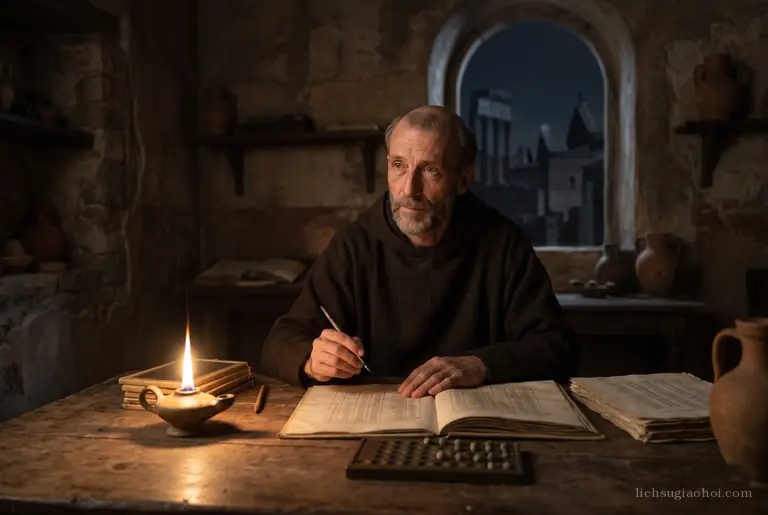
He probably missed by a few years. Later historians lined up his count with Roman records and the heavens, among them an eclipse of the moon that Josephus notes shortly before Herod’s death, and placed Herod’s death in the spring of 4 BC. Matthew and Luke place the birth in the days of Herod, so most historians put it between 6 and 4 BC. The English monk Bede, who died in 735, used the new count in his Ecclesiastical History of the English People, and from there it spread across Western Europe and became the common calendar of the world. Roman numerals had no zero, so the year after 1 BC is AD 1. The slip was the monk’s, not the Gospels’.
Thirty Years No One Knew
From here the Gospels fall almost silent for nearly thirty years. Only one story is told.
When Jesus was twelve, on the threshold of religious adulthood for a Jewish boy, the whole family went up to Jerusalem for the Passover, as they did every year (Luke 2:41–42). Because bandits lurked along the mountain roads, Galileans went up to the feasts in large caravans. The men often walked in one company and the women in another, and a boy of twelve could move freely between them, and could easily have been walking and laughing with cousins. Joseph and Mary had gone a full day on the road home, “supposing him to be in the company” (Luke 2:44). When the group stopped at dusk, they looked for him among relatives and friends and could not find him. A sudden chill of fear went through them. At first light they turned back to Jerusalem and searched every lane, market, and courtyard of the city for three days.
At last they found him, Luke writes, “in the temple, sitting in the middle of the teachers, both listening to them and asking them questions.” All who heard him “were amazed at his understanding and his answers” (Luke 2:46–47).
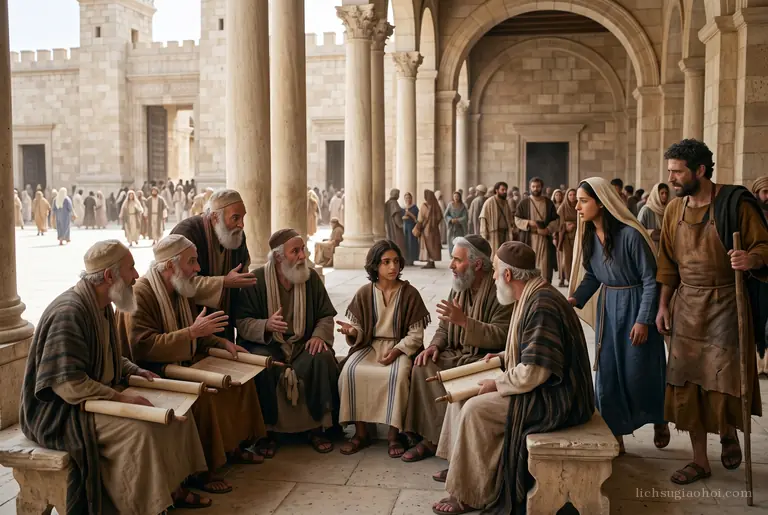
Mary scolded him, as any mother would: “Son, why have you treated us this way? Behold, your father and I were anxiously looking for you.” He answered: “Why were you looking for me? Didn’t you know that I must be in my Father’s house?” (Luke 2:48–49). These are the first words of Jesus recorded in the Gospels. Right after Mary had said “your father and I,” he lifted their eyes to the Most High. Mary had said “your father,” meaning Joseph; Jesus answered with “my Father,” meaning God. They did not understand what he meant, and his mother “kept all these sayings in her heart” (Luke 2:51). Catholics pray over this scene as the fifth Joyful Mystery of the Rosary.
Then the boy went home to Nazareth and, Luke says, “was subject to them.” For the next eighteen years the Gospels tell nothing more. Later writers invented tales to fill the gap: the boy Jesus shapes sparrows out of clay and claps his hands to make them fly away, or strikes down children who spoil his games. These come from the Infancy Gospel of Thomas, a second-century apocryphal work, but the Church never accepted those books as Scripture.
His neighbors in Nazareth later called him “the carpenter” (Mark 6:3) and “the carpenter’s son” (Matt 13:55). The Greek word, tektōn, means a builder who worked in wood and also in stone. In a country village that meant wooden plows, yokes for oxen, house doors, roof beams, and dressed stone for courtyard walls. Justin Martyr, a Christian writer born around AD 100 in Samaria, just south of Galilee, said that Jesus “was in the habit of working as a carpenter when among men, making ploughs and yokes.”
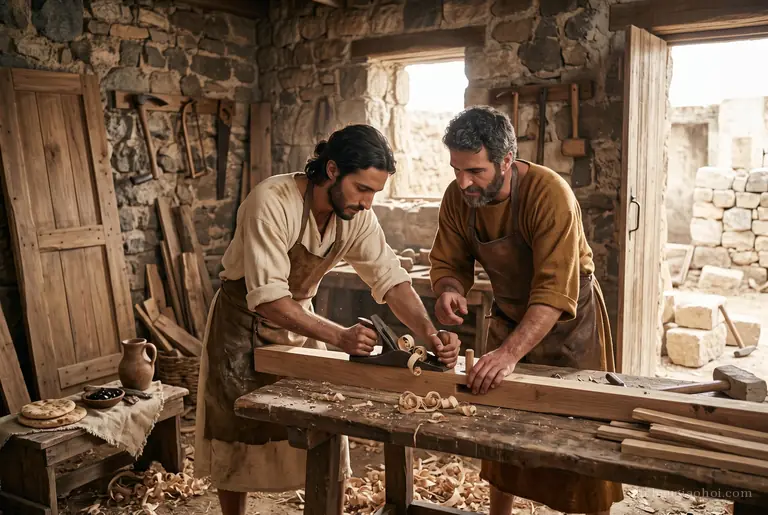
Perhaps father and son walked at dawn with their tool bags to Sepphoris, only about four miles (six kilometers) away. Josephus says that Herod Antipas, the son of Herod the Great who ruled Galilee, rebuilt the city after the fire and made it “the ornament of all Galilee,” in the Greek and Roman style, a project that went on for decades and drew stonemasons, joiners, and builders from every village around. The Gospels never name Sepphoris, and this is only a guess. A village craftsman of that time would have had calloused hands, sweat on his forehead, and a plain table: coarse barley bread, olives in brine, dried figs, and on a good day a grilled fish from the lake. A yoke shaved smooth so it would not rub sores into an ox’s shoulder, a tabletop planed level and delivered on the day promised, a simple supper with his mother and father: ordinary work, made holy by the hands of the Son of God.
The Son of God spent more than nine-tenths of his life on earth like this, as a craftsman in a village no one knew. The Second Vatican Council, in Gaudium et Spes, “Joy and Hope,” put the truth into a few plain lines: “He worked with human hands, He thought with a human mind, acted by human choice and loved with a human heart” (Gaudium et Spes 22).
Luke closes these years with one sentence: Jesus “increased in wisdom and stature, and in favor with God and men” (Luke 2:52).
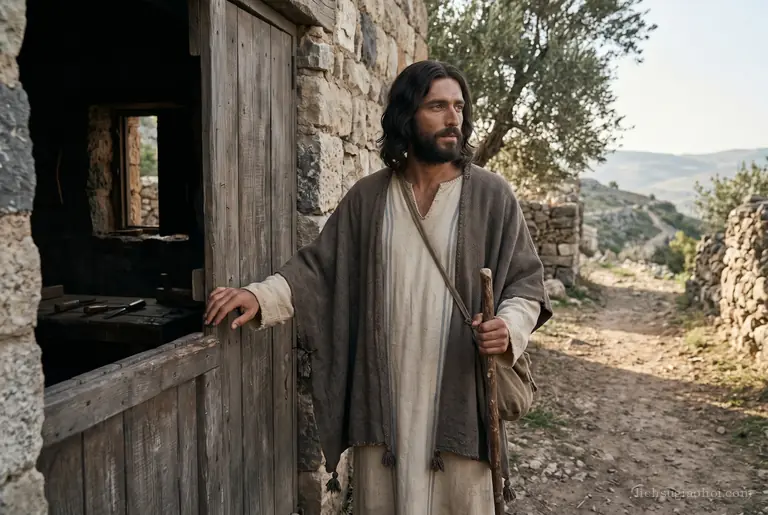
Joseph is never mentioned again; most think he had died by then, and fallen asleep in the Lord. Then one day, at about the age of thirty (Luke 3:23), the carpenter of Nazareth laid his chisel back in its chest, brushed the sawdust from his clothes, shut the workshop door, said goodbye to his mother, and walked south down the dirt road toward the Jordan valley.
Where to Find Them Today
The Annunciation is kept on March 25. In Nazareth the Basilica of the Annunciation rises over the grotto with the words Verbum caro hic factum est. The basilica was finished in 1969, and in 2009 archaeologists found the foundations of a first-century house right beside it. A few steps away, the Church of Saint Joseph stands where tradition places the family’s house and workshop.
Saint Joseph has two days: March 19, and May 1 as Joseph the Worker.
The Visitation is kept on May 31. At Ein Karem, a green hillside neighborhood on the western edge of Jerusalem, where tradition places the home of Zechariah and Elizabeth, the Church of the Visitation has the words of the Magnificat set in tiles on its courtyard wall, in dozens of languages.
The Church of the Nativity in Bethlehem, in the West Bank just south of Jerusalem, goes back to Constantine around 330. It is entered by a doorway so low that visitors must stoop, the “Door of Humility.” In the grotto below the altar, a silver star with fourteen points marks the spot with the words Hic de Virgine Maria Jesus Christus natus est, “Here Jesus Christ was born of the Virgin Mary.”
The Presentation in the Temple falls on February 2, forty days after Christmas, when many parishes bless candles in memory of Simeon’s “light for revelation to the nations.”
The Holy Innocents are honored on December 28. Beneath the Church of Saint Catherine, next to the Basilica of the Nativity, a grotto bears their name.
The Magi are celebrated at Epiphany. Cologne Cathedral has kept relics venerated as theirs since 1164, now in a great golden shrine behind the high altar.
The Holy Family has its feast on the Sunday after Christmas. The Gospels give no route for the flight into Egypt, so maps trace it only with a dotted line. In Old Cairo, the Coptic Church of Saints Sergius and Bacchus is built over a crypt where, by Coptic tradition, the family rested in Egypt, and the Coptic Church keeps June 1 as the day of their arrival.