Đọc thử · Chương 3 · Tiếng Anh
The Carpenter Sets Out to Preach
Around AD 28 to 30 · The Jordan River, the Judean desert, the Sea of Galilee
Luke dates this moment with unusual care, as an ancient historian would, pinning it to the calendar and to living rulers. It was “the fifteenth year of the reign of Tiberius Caesar,” he writes, when Pontius Pilate was governor of Judea, Herod Antipas was tetrarch of Galilee, his brother Philip tetrarch of Ituraea and Trachonitis, Lysanias tetrarch of Abilene, and Annas and Caiaphas held the high priesthood in Jerusalem (Luke 3:1–2). Tiberius had become emperor in AD 14, so the year was around AD 28 or 29. Every one of those men is known from other ancient sources, from bronze and silver coins, stone inscriptions, and the Roman and Jewish historians, which is why historians can fix this story so firmly in time.
In that year people began to talk about a strange man in the wilderness beside the Jordan River. He wore a garment of camel’s hair with a leather belt around his waist, and he ate locusts and wild honey (Mark 1:6). His clothes recalled the prophet Elijah (2 Kgs 1:8). Elijah had been taken up to heaven in a whirlwind, with a chariot of fire, and God had promised to send him back: “Behold, I will send you Elijah the prophet before the great and terrible day of the LORD comes” (Mal 4:5). Many Jews believed that no prophet had spoken in Israel for more than four hundred years.
He did not preach in the Temple or ask the high priests’ council for permission, although he came from a priestly family himself and had every right to climb the Temple steps in linen vestments to burn incense (Luke 1:5). He stood by the river and called out: “Repent, for the Kingdom of Heaven is at hand!” (Matt 3:2). Those who believed him went down into the water, and he dipped them under as a sign that they wanted to begin their lives again: the old life buried under the water, a new one coming up out of it. The Jordan was the river Israel had crossed under Joshua to enter the Promised Land after forty years in the desert (Josh 3). That crossing lay more than a thousand years in the past. Now John called the people out of their towns and back into that same river, as if the whole nation had to make a new crossing. Matthew says the people were “baptized by him in the Jordan, confessing their sins” (Matt 3:6).
His name was John, and people called him John the Baptist, from the Greek word baptizein, “to dip” or “to immerse.” He was John the Immerser. He was the son of the priest Zechariah and of Elizabeth, who had greeted Mary in the last chapter, and so he was a relative of Jesus. He was the child who had leaped in his mother’s womb at the sound of Mary’s greeting, some thirty years before (Luke 1:41). Luke introduces his call in the words once used for Jeremiah and Isaiah: “the word of God came to John, the son of Zacharias, in the wilderness” (Luke 3:2).
The crowds came. They came from Jerusalem, from the hill towns of Judea, and from the whole Jordan valley: farmers and householders shoulder to shoulder with tax collectors, despised as traitors who had sold themselves to foreign masters, and armed soldiers serving the rulers. “What then must we do?” they asked him (Luke 3:10). John asked for no special rites, and he did not tell them to live on locusts in the desert as he did. He gave each group a plain answer. To the crowd he said: “He who has two coats, let him give to him who has none. He who has food, let him do likewise” (Luke 3:11). To the tax collectors he said: “Collect no more than that which is appointed to you.” To the soldiers: “Extort from no one by violence, neither accuse anyone wrongfully. Be content with your wages” (Luke 3:13–14).
People began to wonder “whether perhaps he was the Christ” (Luke 3:15). John told everyone that he was only the man who prepares the way: “he comes who is mightier than I, the strap of whose sandals I am not worthy to loosen” (Luke 3:16). Untying a master’s sandals was a slave’s job. A disciple owed his rabbi almost every service, fetching water, preparing food, carrying his cloak. The rabbis later taught that a student should do every service for his teacher except that one.
One day, among the crowd waiting by the river, stood a carpenter from Nazareth.
Beside the Jordan
Jesus came to the river like everyone else, with no fanfare and no followers, took his place among the penitents, and asked John to baptize him.
John knew who stood before him and, overwhelmed, tried to stop him: “I need to be baptized by you, and you come to me?” (Matt 3:14). Jesus answered: “Allow it now, for this is the fitting way for us to fulfill all righteousness” (Matt 3:15). And he stepped down into the water.
John’s baptism was a sign of repentance: people went down into the water to show that they wanted to turn from their sins and begin again. The man whom Christians believe to be without sin went down into the same water as everyone else.
Jesus came up out of the water and was praying (Luke 3:21). Then, the Gospels say, the heavens were “torn open” (Mark 1:10), the Spirit came down on him “in a bodily form like a dove” (Luke 3:22), and a voice from heaven said: “This is my beloved Son, with whom I am well pleased” (Matt 3:17). In Luke’s version the voice speaks to Jesus himself: “You are my beloved Son. In you I am well pleased” (Luke 3:22). The words echo two lines of the Old Testament. The first is from Psalm 2, a song for the crowning of a king of David’s line (Ps 2:7). The second is from the first of Isaiah’s songs about the LORD’s servant, the gentle servant who would not shout or break a bruised reed, and who would later suffer in silence for others (Isa 42:1–3). Christians have long seen all three Persons of the Trinity at the river: the Father’s voice, the Son in the water, the Spirit in the form of a dove. The Eastern Churches call the Baptism a Theophany, a showing of God.
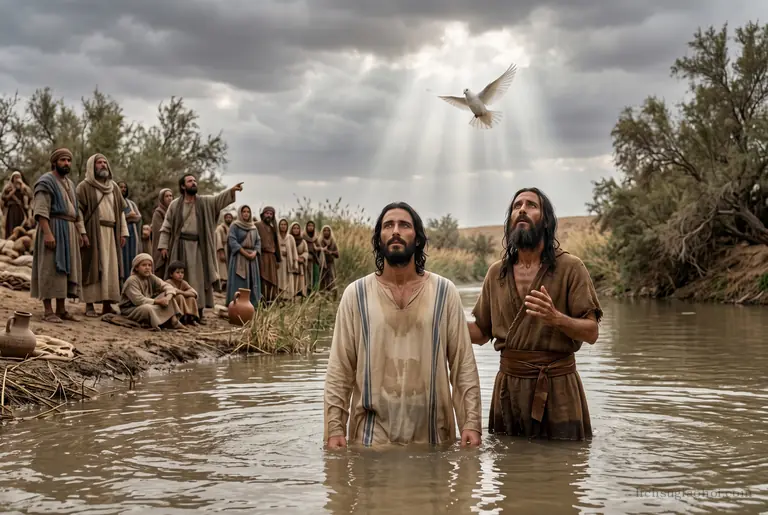
John’s Gospel remembers what the Baptist said the next day, when he saw Jesus coming toward him: “Behold, the Lamb of God, who takes away the sin of the world!” (John 1:29). A Jewish listener would think of the lamb killed at Passover, whose blood brushed on the doorposts had saved Israel in Egypt, and of the silent lamb led to the slaughter in Isaiah (Isa 53:7). It happened, the Gospel says, in “Bethany beyond the Jordan, where John was baptizing” (John 1:28). Today pilgrims visit two sites that face each other across the river, Al-Maghtas on the eastern bank in Jordan and Qasr al-Yahud on the western bank, in the West Bank. The Jordanian site, Al-Maghtas, where archaeologists have uncovered the foundations of Byzantine churches and stepped baptismal pools, was named a UNESCO World Heritage Site in 2015. Catholics hear an echo of John’s words at every Mass, when the priest holds up the Host before Communion and says: “Behold the Lamb of God, behold him who takes away the sins of the world.” The Church keeps the feast of the Baptism of the Lord on the Sunday after Epiphany. It closes the Christmas season and opens Ordinary Time.
The Hebrew word Messiah and the Greek word Christ both mean “anointed one.” Peter would later tell the Roman centurion Cornelius that “God anointed Jesus of Nazareth with the Holy Spirit and with power” (Acts 10:38). In ancient Israel, kings and high priests were anointed when they took office: fragrant olive oil was poured from a horn over their heads. That is where the words Mashiah and Christos come from. There was no horn of oil at the Jordan, no priests in procession, no royal trumpet. Here, God himself anoints Jesus with the Holy Spirit.
Forty Days
Most onlookers would have expected Jesus to gather the crowds and march up to Jerusalem to claim David’s throne. But Jesus did not go straight up to Jerusalem to claim a throne. Mark uses one of the strongest verbs in his Gospel: the Spirit “immediately drove him out into the wilderness” (Mark 1:12).
The Judean wilderness is a stretch of dry limestone hills that fall away toward the Dead Sea, the lowest dry land on earth, about 1,400 feet (430 meters) below sea level. It is not a desert of sand dunes. It is buckled limestone and bleached chalk ridges, cut by dizzying ravines and sheer cliffs. The sun beats down like a furnace by day, and bitter winds sweep the gorges at night. It is home to scorpions, vipers, wild goats, and jackals. Jesus stayed there forty days, fasting and alone. Mark adds that he was among the wild animals, and “the angels were serving him” (Mark 1:13).
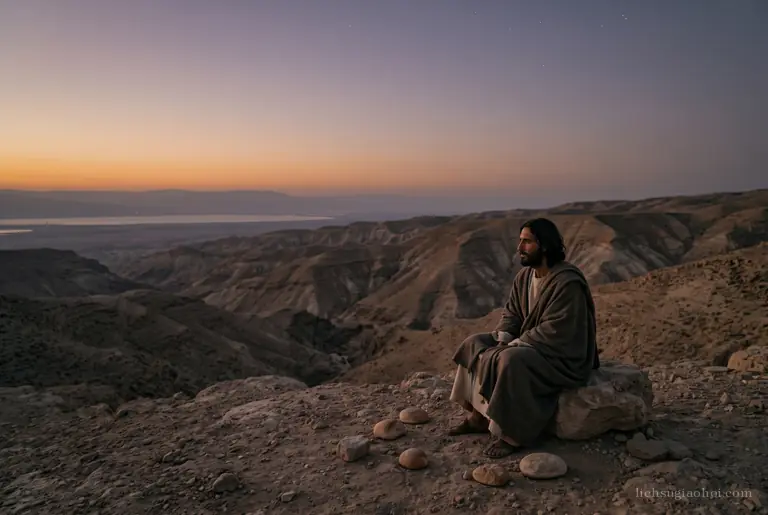
Forty is a number with a history in the Bible. Moses spent forty days on Mount Sinai, eating no bread and drinking no water, to receive the tablets of the Law (Exod 34:28), Elijah walked forty days to the mountain of God (1 Kgs 19:8), and Israel wandered forty years in the desert. There the people lost heart, longed for the pots of meat they had eaten as slaves, and grumbled against God again and again when they were hungry and thirsty. Jesus walks back over the ground where his people had stumbled, and this time he stands firm. In each of his three answers to the tempter, Jesus quotes Deuteronomy, chapters 6 and 8, the book that remembers those forty years (Deut 8:3; 6:16; 6:13).
There he was tempted three times. Each was a shortcut that people expected from a Messiah.
The first came when he was hungry. The desert floor is scattered with round, flat stones, not unlike the small loaves baked in the ovens of Galilee. The tempter said: “If you are the Son of God, command that these stones become bread” (Matt 4:3). In those days most of the poor lived on the edge of hunger, and a Messiah who handed out bread would never lack followers. Jesus answered: “It is written, ‘Man shall not live by bread alone, but by every word that proceeds out of God’s mouth.’” (Matt 4:4). Later, moved with pity for a hungry crowd, he would feed thousands. But he would never use bread as bait to buy people’s hearts.
In the second, the tempter took him to the pinnacle of the Temple (Matt 4:5), high above the deep Kidron valley, and told him to throw himself down. This time the tempter quoted Scripture himself, from Psalm 91: “He will command his angels concerning you,” and, “On their hands they will bear you up, so that you don’t dash your foot against a stone” (Matt 4:6). A prophet who leaped in front of tens of thousands of pilgrims and landed unhurt would have all Jerusalem on its knees, and would never be doubted. Jesus answered: “You shall not test the Lord, your God” (Matt 4:7). He did not want a faith forced out of people by a spectacle.
In the third, the tempter showed him all the kingdoms of the world and said: “I will give you all of these things, if you will fall down and worship me” (Matt 4:9). Many Jews longed for exactly this: a conquering prince, sword in hand, who would drive the Roman legions into the sea and restore the kingdom of David. The price was worship of the tempter, and with it the road of power and the sword. Whoever rules by the sword must first bow to the law of violence. Jesus refused: “Get behind me, Satan! For it is written, ‘You shall worship the Lord your God, and you shall serve him only’” (Matt 4:10).
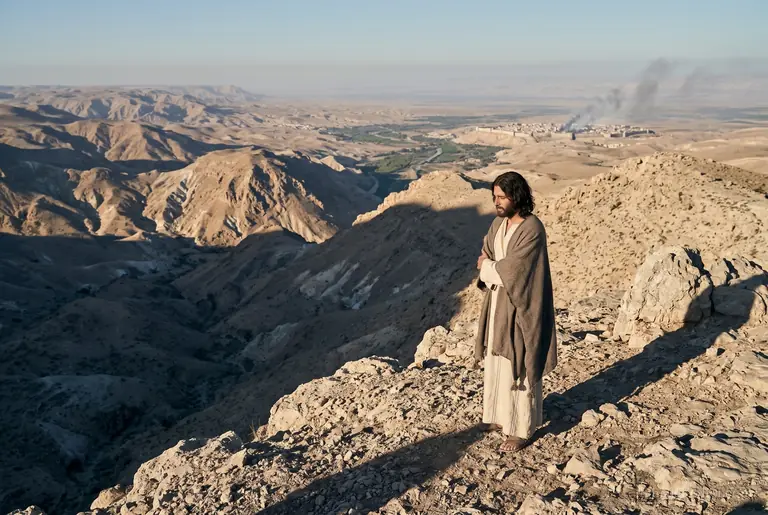
Matthew ends the scene quietly: angels came and served him (Matt 4:11). Luke tells the same three temptations in a different order (Luke 4:1–13), so that his account ends on the pinnacle of the Temple in Jerusalem, the city where Jesus’ last struggle would take place. The Church remembers these forty days every year in Lent, with fasting, prayer, and almsgiving, and on its first Sunday the Gospel is always one of these three accounts.
He walked out of the wilderness with none of the three: no bread to hand out, no miracle to put on show, no sword.
The Kingdom Is Near
Soon afterward Herod Antipas, tetrarch of Galilee and Perea, had John arrested, because John had dared to tell him that he had no right to take his brother’s wife: “It is not lawful for you to have your brother’s wife” (Mark 6:18). To marry Herodias, Antipas had sent away his own wife, the daughter of the Nabataean king Aretas. While the courtiers flattered and kept silent, John told him to his face. Mark adds that Herod “feared John, knowing that he was a righteous and holy man, and kept him safe,” and though John’s words left him perplexed, he liked to listen to him (Mark 6:20). It was Herodias who “set herself against him and desired to kill him” (Mark 6:19).
The Jewish historian Josephus, writing some sixty years later in his Antiquities of the Jews, tells the other side of the story, and he tells it as a tale of court politics. Antipas had been married for many years to the daughter of Aretas, king of the Nabataean Arabs, whose capital was Petra. On a journey to Rome he lodged with his half-brother, fell in love with his brother’s wife Herodias, and agreed to marry her, on one condition: he would send away the daughter of Aretas. The princess learned of the plan before he knew she had learned it. She asked, as if on a whim, to be sent to Machaerus, a grim fortress on the border. From there her father’s officers passed her from one post to the next until she reached Petra and told her father everything. Years later Aretas went to war, and the army of Antipas was destroyed.
Here Josephus stops to write the only account of John that has come down to us from an ancient writer who was not a Christian: “Now some of the Jews thought that the destruction of Herod’s army came from God, and that very justly, as a punishment of what he did against John, that was called the Baptist: for Herod slew him, who was a good man, and commanded the Jews to exercise virtue, both as to righteousness towards one another, and piety towards God, and so to come to baptism.”
He gives the ruler’s own reason as well. When the crowds came to John, “for they were very greatly moved by hearing his words,” Herod feared “lest the great influence John had over the people might put it into his power and inclination to raise a rebellion.” So John “was sent a prisoner, out of Herod’s suspicious temper, to Macherus, the castle I before mentioned, and was there put to death.” The Gospels and Josephus give different reasons, the Gospels a moral rebuke of an unlawful marriage, Josephus the fear of a client prince terrified of unrest. The two fit together, and both accounts end in the same fortress, on a bare volcanic peak east of the Dead Sea.
After John was arrested, Jesus went into Galilee and began to preach (Mark 1:14).
He left Nazareth, tucked away in the hills, and settled in Capernaum, a fishing and trading town on the northwest shore of the Sea of Galilee (Matt 4:13), near the trade routes linking Damascus with the Mediterranean coast, a crossroads where fishermen, merchants, craftsmen, Roman soldiers, and travelers brushed shoulders every day. The local people called the lake a sea; John also calls it “the Sea of Tiberias” (John 6:1). It is a freshwater lake shaped roughly like a harp, about thirteen miles (twenty-one kilometers) long and eight miles (thirteen kilometers) across at its widest, and its shore lies about seven hundred feet (210 meters) below sea level. Capernaum’s houses and alley walls were built of black basalt, the stone of the volcanic hills that ring the lake. Visitors can still walk among the ruins. A modern eight-sided church stands on pillars over the remains of a first-century fisherman’s house that Christians have honored as Peter’s. A church was already standing there when, in the early 380s, a pilgrim named Egeria, a devout woman from the far west of the empire, probably from Spain, came to see it. Her account survives through a later monk, Peter the Deacon.
In Capernaum a church has been made out of the house of the prince of the apostles, and its walls still stand today just as they were. There the Lord healed the paralytic.
Josephus, who commanded the Jewish forces in Galilee a generation after Jesus and knew the lake well, could not stop praising it. Its waters, he wrote, “are sweet, and very agreeable for drinking,” and “there are several kinds of fish in it, different both to the taste and the sight from those elsewhere.” The plain of Gennesaret, on the northwest shore a short walk from Capernaum, was so fertile that walnuts, palms, figs, and olives grew there side by side: “One may call this place the ambition of nature, where it forces those plants that are naturally enemies to one another to agree together.” Grapes and figs could be picked ten months of the year. A strong spring watered the plain, and Josephus even gives its name: “The people of the country call it Capharnaum.”
He walked the breezy pebble shore and went into the synagogues on the Sabbath. The first words of his preaching, as Mark records them: “The time is fulfilled, and God’s Kingdom is at hand! Repent, and believe in the Good News” (Mark 1:15).
“Kingdom of God,” or “Kingdom of Heaven,” was the heart of his preaching. Matthew, writing for Jewish readers, prefers “Heaven,” a respectful way of avoiding God’s name. People who heard the word “kingdom” thought of land, borders, a throne, and an army. This Kingdom has no borders and no army. Jesus himself would later tell Pilate: “My Kingdom is not of this world” (John 18:36).
Put simply, the Kingdom is God’s rule: God reigning in people’s hearts and in the way they live with one another. It cannot be shaded in on a map. It comes alive wherever people put God first and treat one another with self-giving love and forgiveness, instead of the law of the strong devouring the weak. It does not wait for the end of the world or for death. Jesus said it had already begun, in him and in what he did, when he bent over the sick and sat at table with sinners, though it was not yet complete, like a farmer’s seed. The harvest has begun when the grain slips into the earth, yet he must still wait through sun and rain until the stalks ripen. Christians live between those two words, “already” and “not yet,” to this day. Every time Catholics pray the prayer he taught them, they ask for it: “Let your Kingdom come” (Matt 6:10).
He asked two things of his hearers: to repent and to believe. The Greek word behind “repent,” metanoia, means a change of mind, a new way of seeing. It is less about beating one’s breast over the past than about turning around, like a boatman who has let the current carry him and now pulls hard on the oar to turn the bow. Someone who once climbed over other people’s shoulders learns to stoop and serve, and someone raised on “an eye for an eye” learns to forgive. To believe means to place your whole life in God’s hands, your fears, your future, your weakness, like a small child throwing himself into his father’s arms. That is much more than agreeing that God exists.
On the Mountain
Matthew gathers the heart of this teaching into one long sermon. The crowds had come from Galilee, the Ten Cities, Jerusalem, Judea, and beyond the Jordan. Seeing them, Jesus “went up onto the mountain,” a green hillside above the northern shore, sat down on the grass as rabbis did, and his disciples came to him (Matt 5:1). He began with eight blessings, which Christians call the Beatitudes:
“Blessed are the poor in spirit, for theirs is the Kingdom of Heaven. Blessed are those who mourn, for they shall be comforted. Blessed are the gentle, for they shall inherit the earth. Blessed are those who hunger and thirst for righteousness, for they shall be filled. Blessed are the merciful, for they shall obtain mercy. Blessed are the pure in heart, for they shall see God. Blessed are the peacemakers, for they shall be called children of God. Blessed are those who have been persecuted for righteousness’ sake, for theirs is the Kingdom of Heaven” (Matt 5:3–10).
Everyone knew whom the world called blessed: landowners with full barns, men with friends in Tiberias and Rome, the strong, the well fed. Jesus named the poor, the grieving, the gentle, and the persecuted. In the same sermon he reached down to the hidden roots of the heart, where anger festers before murder and lust before betrayal. He told his hearers that the Father “makes his sun to rise on the evil and the good,” and told them to “love your enemies, bless those who curse you, do good to those who hate you, and pray for those who mistreat you and persecute you” (Matt 5:44). He told them not to blow a trumpet when they gave alms, to pray in secret, where only the Father sees, and not to fret about tomorrow, because the Father who feeds the birds of the air and clothes the wildflowers knows what they need (Matt 6). Luke gives a shorter version of the sermon, spoken on a level place (Luke 6:17–49). Christian tradition sets Matthew’s mountain on a hillside above the lake, a little west of Capernaum.
His disciples often watched him slip away at dawn and stay late into the night talking with the Father. One day, when he had finished praying, one of his disciples asked him: “Lord, teach us to pray, just as John also taught his disciples” (Luke 11:1). He gave them a prayer short enough for a child to learn by heart: “Our Father in heaven, may your name be kept holy. Let your Kingdom come. Let your will be done on earth as it is in heaven. Give us today our daily bread. Forgive us our debts, as we also forgive our debtors. Bring us not into temptation, but deliver us from the evil one” (Matt 6:9–13). No prayer has been said more often in the two thousand years since. Its seven petitions have been whispered by martyrs in Roman arenas, chanted in monastery choirs, and murmured by parents over feverish children.
Stories by the Lake
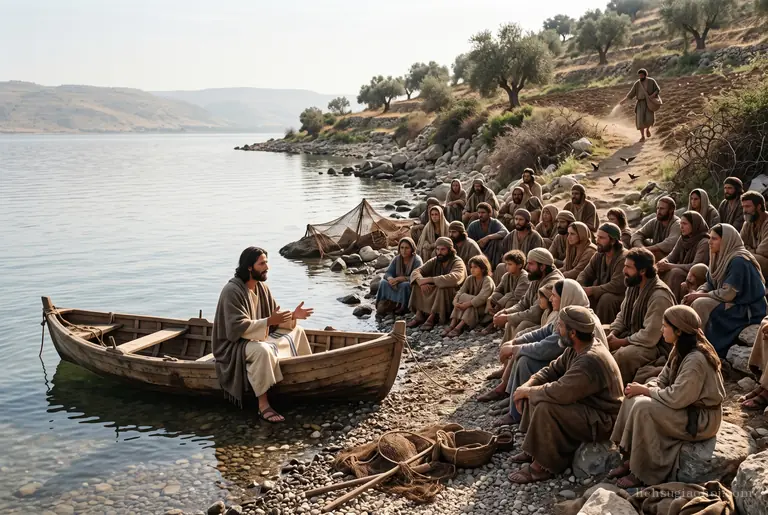
Jesus did not teach like the scribes, the experts who copied and explained the Law of Moses and quoted earlier masters one after another: “Rabbi so-and-so taught this.” People noticed that he taught “as having authority, and not as the scribes” (Mark 1:22). He told parables, short stories taken from daily life. Matthew says that “without a parable, he didn’t speak to them” (Matt 13:34). Farmers, housewives, and shepherds could follow them. Sometimes the crowd packed the shore so tightly that there was nowhere to stand, and he sat in a boat pushed out a little way, so that his voice carried across the calm water to the people on the beach (Matt 13:1–2).
A man went out to sow seed. As he swung his arm, the grain flew in wide arcs. Some seed fell on the hard-packed path, and birds ate it. Some fell on rocky ground, a thin layer of soil over limestone; it sprang up fast, and “when the sun had risen, they were scorched. Because they had no root, they withered away” (Matt 13:6). Some fell among thorns, which choked it. Some fell on good soil and bore fruit: “some one hundred times as much, some sixty, and some thirty” (Matt 13:8). Every farmer listening knew those four kinds of ground; the terraced hillsides behind the lake were full of them. Jesus explained that the seed was “the word of the Kingdom” (Matt 13:19), and the four kinds of ground were four ways of hearing it.
A merchant was looking for fine pearls. When he found one of great price, he hurried home and “sold all that he had” to buy it (Matt 13:46). Letting go of lesser things is no longer a loss when a man gives up everything for joy.
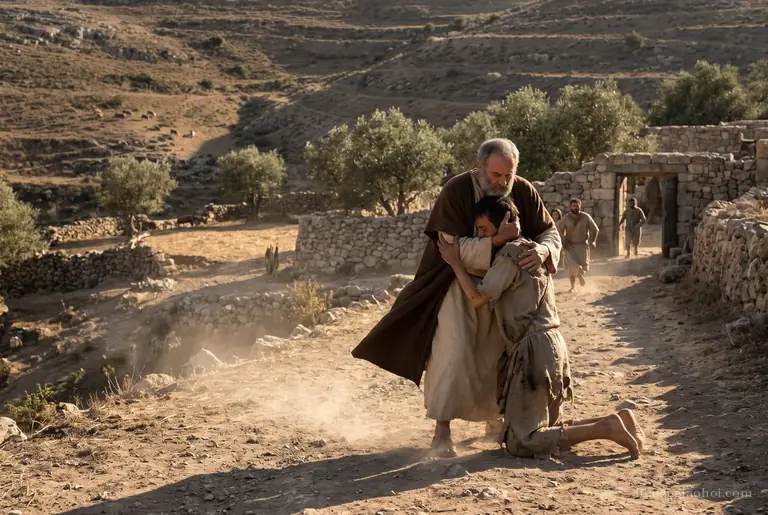
A man had two sons. The younger demanded his share of the inheritance while his father was still alive, left for a far country, and spent everything. Then “there arose a severe famine in that country” (Luke 15:14). He hired himself out to a local man, a Gentile, who sent him into the fields to feed pigs, which to Jewish listeners was the lowest work imaginable, since pigs were unclean animals. A son of Abraham among the pigs had hit bottom. Luke says he “wanted to fill his belly with the pods that the pigs ate, but no one gave him any” (Luke 15:16). Starving, “he came to himself” (Luke 15:17) and decided to go home and ask to be one of his father’s hired servants, and he rehearsed his confession on the dusty road. But while he was still far off, his father saw him and “was moved with compassion, and ran, fell on his neck, and kissed him” (Luke 15:20). The son never finished his speech. The father told the servants: “Bring out the best robe and put it on him. Put a ring on his hand and sandals on his feet. Bring the fattened calf, kill it, and let’s eat and celebrate” (Luke 15:22–23). He called for a feast, “for this, my son, was dead and is alive again. He was lost and is found” (Luke 15:24).
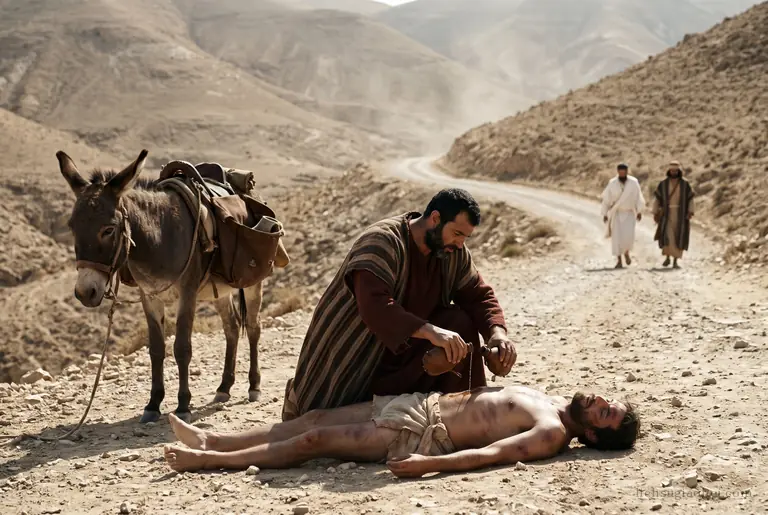
Once a lawyer, an expert in the Law, asked him to test him. The Law said to love your neighbor as yourself. “Who is my neighbor?” (Luke 10:29). Jesus gave no definition. He told a story about the road from Jerusalem down to Jericho. That road runs about 17 miles (27 kilometers) through bare limestone hills, from Jerusalem, more than 2,400 feet (750 meters) above sea level, to Jericho, nearly 850 feet (260 meters) below it. Its caves and ravines were notorious as a lair of armed bandits. A traveler “fell among robbers, who both stripped him and beat him, and departed, leaving him half dead” (Luke 10:30). A priest came by and crossed to the other side. Perhaps he was afraid the man was dead: touching a corpse would have made him unclean and kept him from serving in the Temple. A Levite, one of the Temple assistants, did the same. Then a Samaritan stopped. Samaritans lived in the highlands between Galilee and Judea. Their ancestry had been mixed after the Assyrian conquest, and they worshiped on Mount Gerizim rather than in Jerusalem, and, as John writes, “Jews have no dealings with Samaritans” (John 4:9). They were the people many Jews looked down on most.
But the Samaritan, when he saw the man, “was moved with compassion” (Luke 10:33). He “bound up his wounds, pouring on oil and wine,” set the man on his own animal, walked beside it to an inn, and stayed with him there through the night. The next day he gave the innkeeper two denarii, two days’ wages, and said: “Take care of him. Whatever you spend beyond that, I will repay you when I return” (Luke 10:34–35). Then Jesus asked: “Now which of these three do you think seemed to be a neighbor to him who fell among the robbers?” The lawyer answered: “He who showed mercy on him.” He could not, it seems, perhaps from wounded national pride, bring himself to say “the Samaritan.” And Jesus said: “Go and do likewise” (Luke 10:36–37).
He scolded no one, neither the priests nor the lawyer, and he did not lecture from above. The story worked like a mirror: whoever looked into it saw his own face.
The Signs
Besides the stories, there were the things he did. John calls them “signs,” windows through which the light of God’s Kingdom broke into a wounded world.
John’s Gospel places the first of them at a village wedding. “The third day, there was a wedding in Cana of Galilee. Jesus’ mother was there” (John 2:1). Jesus and his newly gathered disciples had been invited too. Partway through the feast the wine ran out, a crushing humiliation for the bridegroom and his family in a village where a wedding feast could go on for days. Mary noticed the quiet panic first and told her son: “They have no wine.” His answer sounds abrupt to modern ears: “Woman, what does that have to do with you and me? My hour has not yet come.” She simply turned to the servants: “Whatever he says to you, do it” (John 2:3–5). Six stone water jars stood nearby, used for Jewish washings, each holding twenty or thirty gallons. Jesus had them filled to the brim and some drawn out for the man in charge of the feast. He tasted it and called the bridegroom over: “Everyone serves the good wine first, and when the guests have drunk freely, then that which is worse. You have kept the good wine until now!” (John 2:10). John adds: “This beginning of his signs Jesus did in Cana of Galilee, and revealed his glory; and his disciples believed in him” (John 2:11). The words Mary spoke to the servants that day are the last words of hers that the Gospels record.
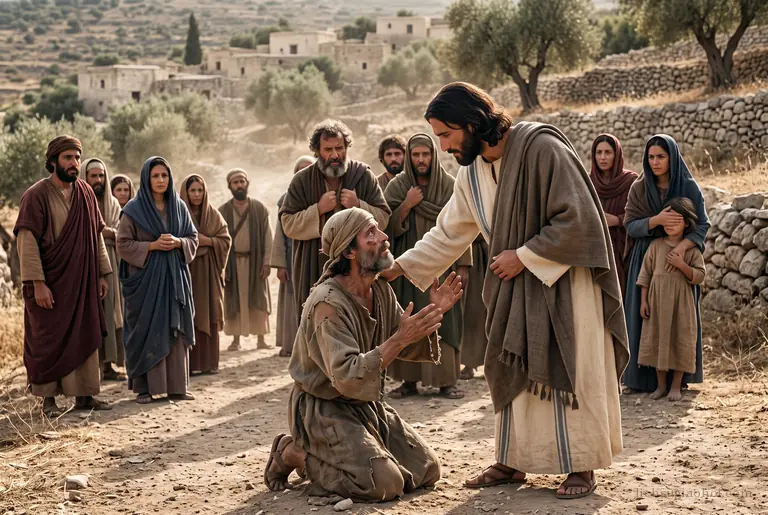
He touched lepers, people driven out of their villages whom no one dared to approach. The word “leprosy” covered true leprosy and a range of disfiguring skin diseases. The Law of Moses told a leper to wear torn clothes, let his hair hang loose, cover his upper lip, and cry out “Unclean! Unclean!” so that others would keep away, and to live alone outside the camp (Lev 13:45–46). One day a leper broke through all of that. He came to Jesus, knelt, and begged: “If you want to, you can make me clean” (Mark 1:40). Mark says Jesus was “moved with compassion,” stretched out his calloused carpenter’s hand, and touched the man’s sores. It was the first human touch he had felt in years. “I want to. Be made clean,” he said (Mark 1:41). Then he sent him to show himself to the priest, who could declare him clean and welcome him back to his family and village. Jesus gave sight to the blind and hearing to the deaf, and mute tongues broke into speech and laughter. He drove out evil spirits and gave peace back to people who had been tormented.
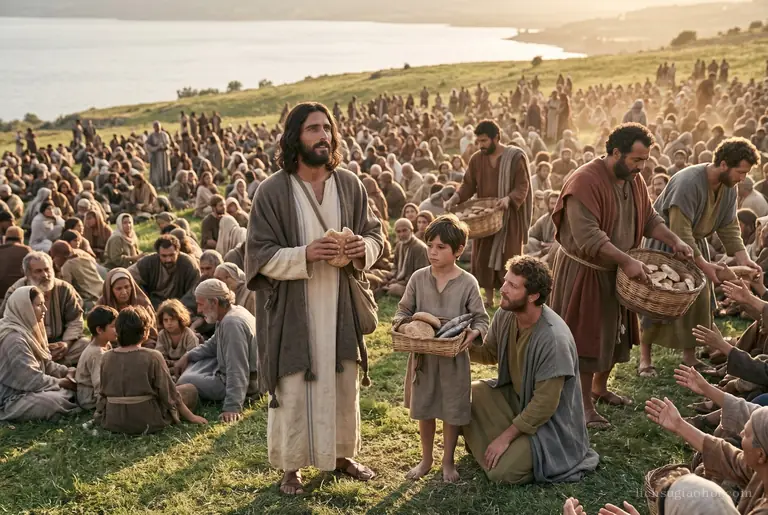
One evening, on a lonely grassy slope beside the lake, as the shadows lengthened, thousands of people who had followed him all day were hungry. The disciples wanted to send them off to the villages to buy food. Jesus told them: “You give them something to eat” (Mark 6:37). Andrew, Simon Peter’s brother, found only five barley loaves and two fish, which belonged to a boy: “but what are these among so many?” (John 6:8–9). Jesus had the people sit down “in groups on the green grass” (Mark 6:39). He took the loaves, looked up to heaven, gave thanks, broke them, and handed them to the disciples to give out. Everyone ate until they were full, and twelve large wicker baskets of scraps were left over. Mark counts “five thousand men” (Mark 6:44), and Matthew adds, “in addition to women and children” (Matt 14:21). Catholics will notice the four actions: he took, gave thanks, broke, and gave. They return at the Last Supper and at every Mass, from dawn to dusk around the world.
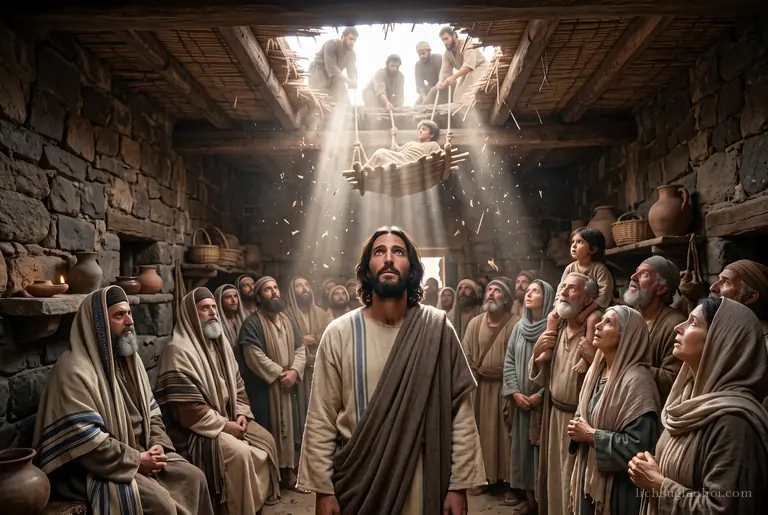
In Capernaum, while Jesus was teaching in a packed house, four men carried a paralyzed friend to him on a mat (Mark 2:3), but the house was so jammed that they could not get near the door. So they hauled him up the outside stairs onto the flat roof, which in houses like those was made of beams overlaid with branches, reeds, and packed clay. Mark says “they removed the roof where he was. When they had broken it up, they let down the mat” (Mark 2:4). Jesus saw their faith and said to the man: “Son, your sins are forgiven you” (Mark 2:5). Some scribes sitting there thought to themselves: “Why does this man speak blasphemies like that? Who can forgive sins but God alone?” (Mark 2:7). Jesus knew what they were thinking and asked them a question. “Your sins are forgiven” is a verdict no eye can check; “Get up” is a command anyone can see tested: “Which is easier, to tell the paralytic, ‘Your sins are forgiven;’ or to say, ‘Arise, and take up your bed, and walk’?” (Mark 2:9). So that they would know that “the Son of Man has authority on earth to forgive sins” (Mark 2:10), Jesus said to the paralyzed man: “I tell you, arise, take up your mat, and go to your house” (Mark 2:11). The man got up, rolled up his mat, put it on his shoulder, and walked out in front of them all. “We never saw anything like this!” the crowd said (Mark 2:12).
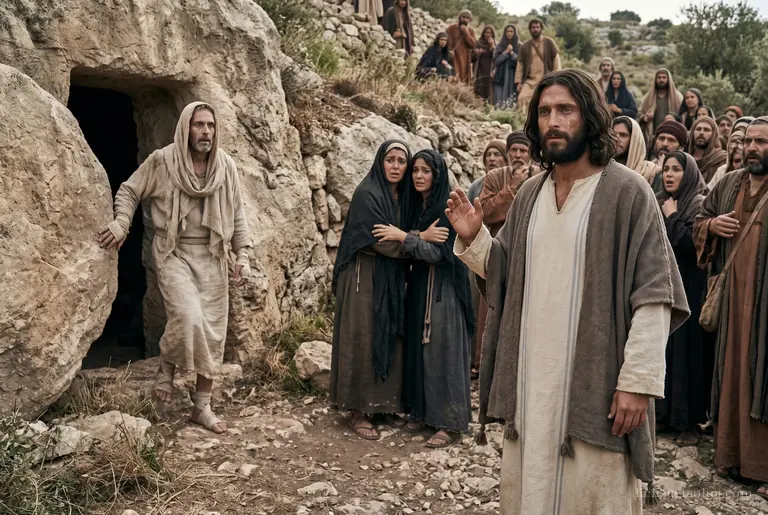
At Bethany, a village on the eastern slope of the Mount of Olives, fifteen stadia, about two miles (three kilometers), from Jerusalem, lived a family Jesus loved: two sisters, Martha and Mary, and their brother Lazarus. This is not the Bethany beyond the Jordan where John baptized. Lazarus fell ill and died and was laid in a tomb cut into the rock, and when Jesus arrived he “had been in the tomb four days already” (John 11:17). A later Jewish tradition held that the soul stays near the body for three days, hoping to return, and leaves when it sees the face begin to change. By the fourth day, everyone at the grave knew there was no hope left.
Jesus saw Mary weeping, and the neighbors weeping with her, and standing outside the cold stone cave he was deeply moved in spirit. Then comes one of the shortest verses in the Bible: “Jesus wept” (John 11:35). He told them: “Take away the stone.” Martha, practical to the end, objected: “Lord, by this time there is a stench, for he has been dead four days” (John 11:39). Jesus looked up and thanked his Father aloud (John 11:41). Then he cried out in a loud voice: “Lazarus, come out!” The dead man came out, “bound hand and foot with wrappings, and his face was wrapped around with a cloth” (John 11:43–44). Today the village is called al-Eizariya, a name that comes from Lazarus, and a tomb there, reached by steep steps cut into the rock, has been shown to pilgrims since at least the fourth century.
John calls such deeds “signs.” He explains why he wrote them down: “these are written that you may believe that Jesus is the Christ, the Son of God, and that believing you may have life in his name” (John 20:31). Through the signs, people caught a glimpse of what the Kingdom would look like: no outcast left outside the gate, no hungry crowd sent away empty, no sin beyond pardon, no sickness beyond pity, and in the end even death forced to step back.
The Ones He Called
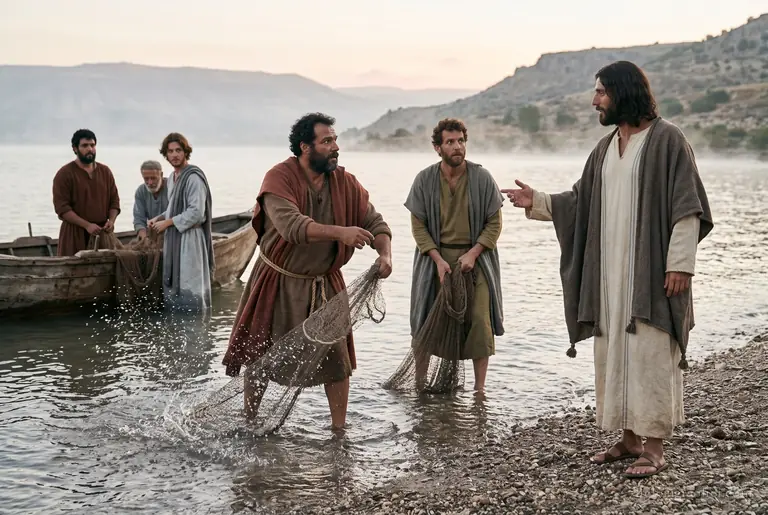
One day by the lake, some fishermen were casting a round net into the shallows. Simon and his brother Andrew, Mark says, were fishermen (Mark 1:16). Jesus walked by and said: “Come after me, and I will make you into fishers for men” (Mark 1:17). They dropped their dripping nets and followed him. A little farther on, he called two other brothers, James and John, who were mending nets in a boat with their father Zebedee and his hired men. They left the boat and their father and followed him.
The fishermen of the lake worked from wooden boats. In 1986, during a drought, the lake sank to a historic low, and two brothers from Kibbutz Ginosar, a farming community on the shore, noticed the curved rim of old timber in the mud. Archaeologists dug it out, preserved it, and dated it by radiocarbon. It was built mostly of cedar and oak around the time of Jesus, and it is about 27 feet (8 meters) long and more than 7 feet (2.3 meters) wide, large enough for several men to row through the sudden squalls of the lake and haul their nets.
Then he passed a tax office and saw a man named Levi, also called Matthew, sitting there. Mark calls him Levi, and the first Gospel tells the same story of a man called Matthew; Christians have always taken them to be one man. An old tradition, from the second-century bishop Papias to Eusebius, names him as the author of the first Gospel. His feast is September 21.
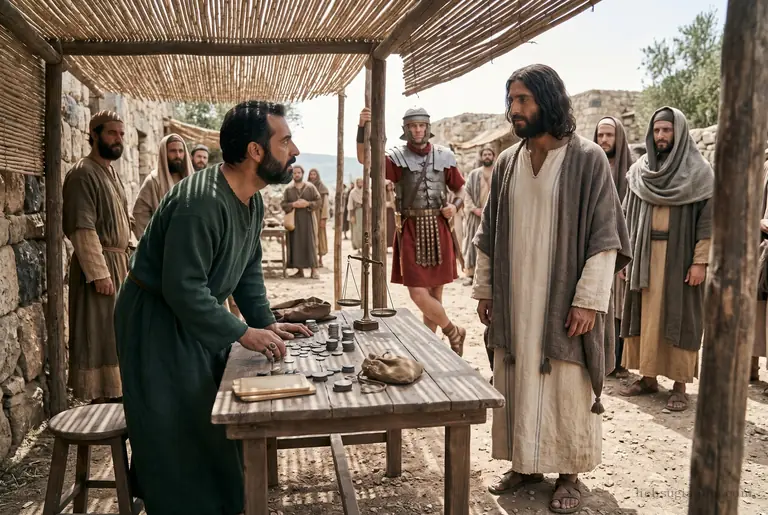
In that time, a tax collector was seen as a man who had sold himself to the foreign rulers. He worked for a government most people resented, and he often took more than he should to fill his own pocket. The Romans often sold the right to collect tolls to local men. The collector paid a fixed sum and kept whatever more he could squeeze out of people. In any occupied country, the neighbor who collects taxes for the foreign rulers is the most despised man in the village. Observant Jews saw such a man as a collaborator and a public sinner, whose doorway no respectable man would cross. Levi’s office in Capernaum probably took tolls on fish and on the goods carried along the lakeside highway. Jesus stopped at his table covered with coins, looked straight at him, and said just two words: “Follow me” (Mark 2:14). He stood up and left everything, the ledgers, the clinking coins, and a comfortable living.
Later Levi gave a great feast in his house, and there was “a great crowd of tax collectors and others” reclining on the couches with Jesus (Luke 5:29). Watching from the doorway, the Pharisees, devout laymen who tried to keep the Law of Moses down to the smallest detail, muttered to his disciples: “Why is it that he eats and drinks with the tax collectors and sinners?” (Mark 2:16). Jesus heard it and answered gently: “Those who are healthy have no need for a physician, but those who are sick. I came not to call the righteous, but sinners to repentance” (Mark 2:17).
One night Jesus went up on a mountain to pray. “He continued all night in prayer to God,” Luke writes, and at daybreak, as the light came over the eastern ridges, he called his followers and chose twelve of them (Luke 6:12–13).
The number twelve had a meaning. Ancient Israel had twelve tribes, descended from the twelve sons of Jacob, but ten of them had been scattered and lost centuries before, when the Assyrians conquered the northern kingdom. To choose twelve men was a way of saying without words that God was gathering his people anew, a new Israel. Jesus said later that they would sit “on twelve thrones, judging the twelve tribes of Israel” (Matt 19:28).
It was a strange group. The Gospels name no famous scribe, no son of the high-priestly families, no man of wealth or rank among them. Four were sun-weathered fishermen from the lake. Jesus gave Simon a new name, Cephas, Aramaic for “rock,” in Greek Peter (John 1:42). He gave James and John the nickname Boanerges, “Sons of Thunder” (Mark 3:17), a wry nod, it seems, to their hot tempers; once they offered to call down fire on a Samaritan village that turned them away (Luke 9:54). There was Matthew, the former tax collector. There was another Simon, called the Zealot (Luke 6:15). Some think he had belonged to a party of men ready to take up the sword against the Romans; others think the word only means a man zealous for the Law. Mark lists the twelve as Simon Peter, James, John, Andrew, Philip, Bartholomew, Matthew, Thomas, James son of Alphaeus, Thaddaeus, Simon the Zealot, and Judas Iscariot, who later betrayed him, named last in every list (Mark 3:16–19).
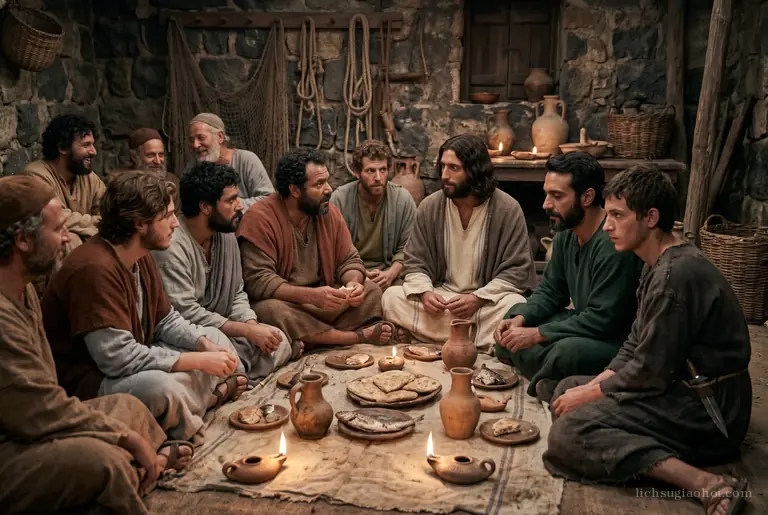
A man who had collected taxes for the rulers and a man who may once have drawn a dagger against the Romans and their friends had to share one table and one road. By every rule of their world they should have been at each other’s throats. Breaking bread from the same dish was a small miracle. Only Jesus held them together.
They followed, listened, watched how he lived, and tried to live the same way. They were called disciples, which means students. Then one day he sent them out two by two into the villages, taking “nothing for their journey, except a staff only: no bread, no wallet, no money in their purse” (Mark 6:7–8). They carried only the message that the Kingdom of Heaven was near. Luke says Jesus also gave the Twelve a second name, apostles, from a Greek word that means “those who are sent” (Luke 6:13). Every Sunday Catholics say in the Creed that the Church is “apostolic,” because it rests on the witness of these twelve ordinary men.
The Road to Jerusalem
Jesus’ fame spread through Galilee and into Judea and Syria. Families carried their sick to him on stretchers from every direction. But along with the crowds came unfriendly eyes. Some Pharisees could not accept that he healed withered hands and bent backs on the Sabbath, the Jewish day of rest (Mark 3:1–6), ate with sinners, and forgave sins, which they said only God can do (Mark 2:7). They were serious people, not villains: Jesus argued with them, and he also sat at their tables (Luke 7:36). Scribes who came down from Jerusalem said, “He has Beelzebul,” a name for the chief of the evil spirits, and said he drove out demons by a league with hell (Mark 3:22).
The chief priests in Jerusalem, the aristocratic families who ran the Temple and walked a narrow line with the Roman power, feared that this teacher from Galilee would stir up the people and bring the Roman army down on them. After the raising of Lazarus, in a village almost at the city gates, the council, the Sanhedrin, met in haste, and John records what was said: “What are we doing? For this man does many signs. If we leave him alone like this, everyone will believe in him, and the Romans will come and take away both our place and our nation” (John 11:47–48). Caiaphas, the high priest that year, cut them short: “You know nothing at all … it is advantageous for us that one man should die for the people, and that the whole nation not perish” (John 11:49–50). His fear was not foolish. Within living memory Rome had drowned Jewish uprisings in blood, as the first chapter showed. People still remembered the smoke over Sepphoris and the two thousand crosses around Jerusalem.
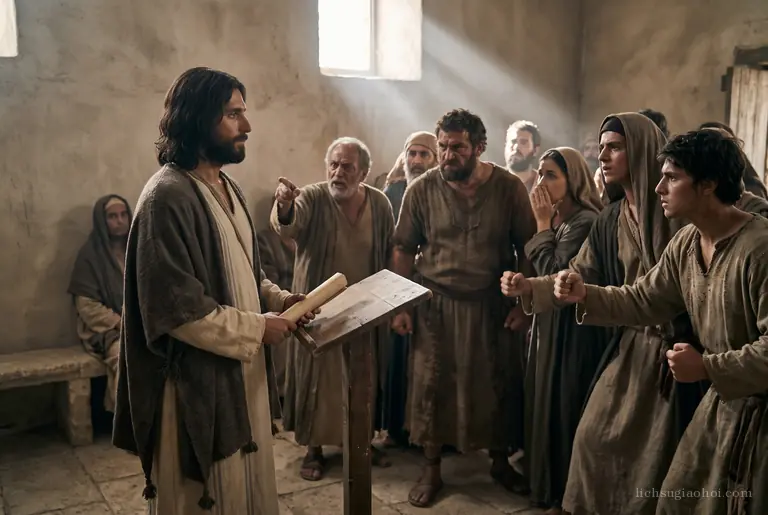
Even the people of Nazareth, who had watched him grow up beside the carpenter’s bench, did not believe. On a Sabbath in their synagogue he stood up to read from the prophet Isaiah: “The Spirit of the Lord is on me, because he has anointed me to preach good news to the poor” (Luke 4:18). Then he rolled up the scroll, handed it back to the attendant, sat down, and said: “Today, this Scripture has been fulfilled in your hearing” (Luke 4:20–21). At first they all spoke well of him and “wondered at the gracious words which proceeded out of his mouth.” Then they asked one another: “Isn’t this Joseph’s son?” (Luke 4:22). Jesus reminded them that in a great famine Elijah was sent to none of the widows of Israel but to a foreign widow in Zarephath of Sidon, and that in Elisha’s day the only leper healed was “Naaman, the Syrian” (Luke 4:25–27). God’s help had gone to outsiders. At that the whole synagogue was “filled with wrath,” and they rose up, drove him out of the town, and dragged him to the brow of the hill their town was built on, to throw him off the cliff. But “passing through the middle of them,” he went his way (Luke 4:28–30). Mark records what they said of him: “Isn’t this the carpenter, the son of Mary” (Mark 6:3). He “could do no mighty work there, except that he laid his hands on a few sick people and healed them. He marveled because of their unbelief” (Mark 6:5–6).
Later, toward the end of his time in Galilee, Jesus took the Twelve far to the north. There, at the green foot of snow-crowned Mount Hermon, among basalt cliffs, the Jordan rises from a deep spring below a dark cave. The place was called Paneas, after the Greek god Pan, whose shrine was in the cave. Herod the Great had built a temple of white marble there in honor of Augustus, and his son Philip rebuilt the town and named it Caesarea. People called it Caesarea Philippi, to tell it from the Caesarea on the coast. Josephus describes the spot: “a dark cave opens itself; within which there is a horrible precipice, that descends abruptly to a vast depth … Now the fountains of Jordan rise at the roots of this cavity outwardly.”
He led the Twelve away from the crowds to the villages around that town, and there, among niches carved for Pan and marble raised to Caesar, asked them: “Who do men say that I, the Son of Man, am?” They told him what people were saying in the marketplaces: “Some say John the Baptizer, some, Elijah, and others, Jeremiah or one of the prophets.” Then he asked: “But who do you say that I am?” Simon Peter answered: “You are the Christ, the Son of the living God” (Matt 16:13–16).
Jesus’ reply, in Matthew, plays on Simon’s new name: “Blessed are you, Simon Bar Jonah, for flesh and blood has not revealed this to you, but my Father who is in heaven. I also tell you that you are Peter, and on this rock I will build my assembly, and the gates of Hades will not prevail against it. I will give to you the keys of the Kingdom of Heaven” (Matt 16:17–19). The Greek word for “assembly” is ekklesia, the word the Church has always used for itself. In Isaiah, the key of David’s house was laid on the shoulder of the king’s chief steward (Isa 22:22). The Catholic Church sees in these words the beginning of the office of Peter, handed down to the bishops of Rome, and two crossed keys still stand on the coat of arms of every pope.
Then, Mark says, Jesus began to teach them that the Son of Man must suffer and be killed and rise again. Peter, who had just spoken so well, took him aside and began to rebuke him. Jesus turned, looked at all the disciples, and said to Peter the hardest words he ever spoke to a friend: “Get behind me, Satan! For you have in mind not the things of God, but the things of men” (Mark 8:31–33).
Six days later he took Peter, James, and John up a high mountain by themselves, “and he was changed into another form in front of them. His clothing became glistening, exceedingly white, like snow, such as no launderer on earth can whiten them” (Mark 9:2–3). Moses and Elijah, the Law and the Prophets in person, appeared and talked with him. Peter, who “didn’t know what to say, for they were very afraid,” offered to build three tents. A shining cloud covered the summit, and the voice heard at the Jordan spoke again: “This is my beloved Son. Listen to him” (Mark 9:5–7). Then they looked around and saw no one but Jesus. Since at least the fourth century, tradition has placed this on Mount Tabor, the round green mountain that rises from the plain of Jezreel southwest of the lake.
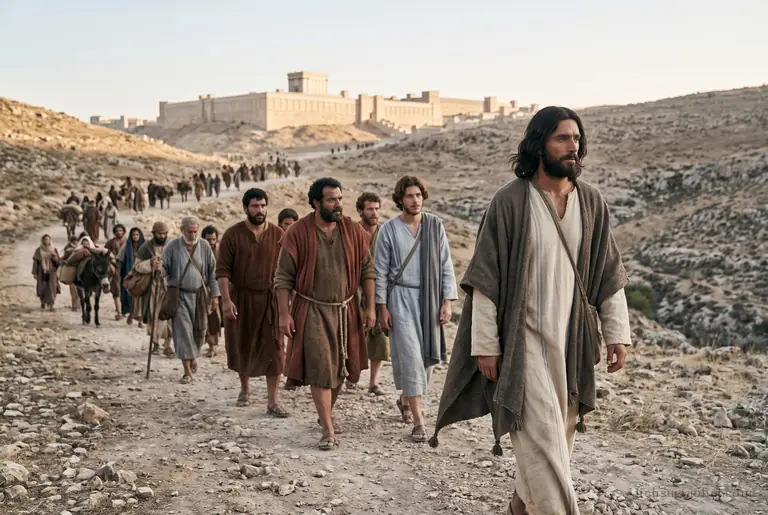
His disciples still dreamed of a kingdom with seats of honor. Walking behind him on the road, they whispered and argued among themselves “about who was the greatest” (Mark 9:34). James and John asked: “Grant to us that we may sit, one at your right hand and one at your left hand, in your glory” (Mark 10:37). But three times Jesus told them what they did not want to hear (Mark 8:31; 9:31; 10:33–34). He used his favorite name for himself, the Son of Man. The phrase could simply mean a frail human being, but it also recalled a figure in a vision in the book of Daniel, who comes with the clouds of heaven and receives everlasting dominion (Dan 7:13–14). The third time he said it plainly: “Behold, we are going up to Jerusalem. The Son of Man will be delivered to the chief priests and the scribes. They will condemn him to death, and will deliver him to the Gentiles. They will mock him, spit on him, scourge him, and kill him. On the third day he will rise again” (Mark 10:33–34). And he told the Twelve what greatness means: “For the Son of Man also came not to be served but to serve, and to give his life as a ransom for many” (Mark 10:45).
Luke puts the turning point in a vivid phrase: “when the days were near that he should be taken up, he intently set his face to go to Jerusalem” (Luke 9:51).
Then, as the Passover of the spring of AD 30 drew near, and the pilgrim roads filled with singing families climbing toward the Temple, Jesus set out for Jerusalem, resolved and free, toward the city where the Cross was waiting. Mark remembers how he walked: “Jesus was going in front of them, and they were amazed; and those who followed were afraid” (Mark 10:32).
Where to Find Them Today
John the Baptist has two feasts: his birth on June 24 and his martyrdom on August 29. The ruins of Machaerus, where he died, stand on a hilltop above the village of Mukawir in Jordan, looking west across the Dead Sea. Matthew is remembered on September 21.
The place of the baptism can be visited from both banks of the Jordan: Al-Maghtas in Jordan, a UNESCO World Heritage Site, and Qasr al-Yahud on the West Bank side, near Jericho. The feast of the Baptism of the Lord falls in early January.
Capernaum is an archaeological park on the northwest shore of the Sea of Galilee. The modern church stands over the house honored as Peter’s, beside the ruins of a white limestone synagogue built a few centuries after Jesus. A church already stood over the house when Egeria came around 380.
The Galilee boat, about 27 feet long, of cedar and oak, is on display at the Yigal Allon Centre at Kibbutz Ginosar, on the lakeshore.
Cana is traditionally placed at Kafr Kanna, near Nazareth, where a Franciscan church remembers the wedding and married couples come to renew their vows.
The Mount of Beatitudes, above the lake near Capernaum, is crowned by an eight-sided church, one side for each Beatitude.
Martha, Mary, and Lazarus are remembered together on July 29. The tomb of Lazarus at al-Eizariya, on the eastern slope of the Mount of Olives just outside Jerusalem, is reached by steep steps cut into the rock.
Caesarea Philippi is now the Banias nature reserve, at the foot of Mount Hermon, where the cold headwaters of the Jordan still rush out below the ancient cave of Pan.
Mount Tabor has the Basilica of the Transfiguration on its summit. The feast of the Transfiguration falls on August 6.